line
Winter Triangle
What you see
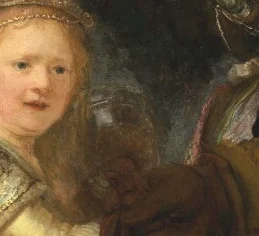
The crop shows the marked area in the original painting. Inspect its shapes, colours and position.
The project’s interpretation
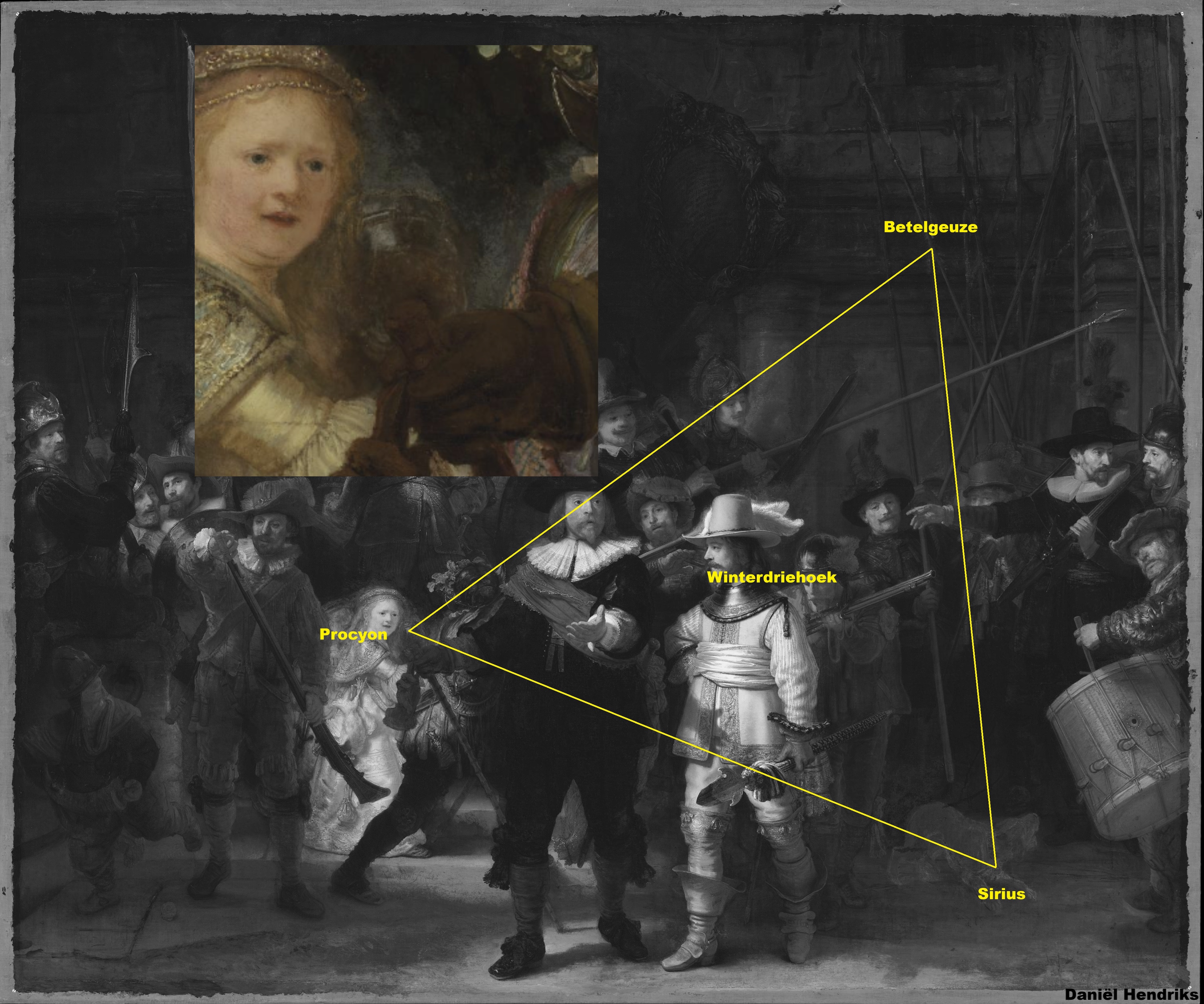
Winter Triangle appears in The Night Watch as a spatial play of three points of light: Betelgeuse glows at the crossing of two spear-tips upper left of Orion, Sirius sparkles on the dog’s medallion and Procyon — not recorded in Blaeu’s tables in 1642 but already described in Antiquity — rests as a small white square next to the mouth of…
Compare for yourself
Use Compare to inspect the original and the project’s interpretation at the same scale.
Open the interactive painting →Full project notes
Winter Triangle appears in The Night Watch as a spatial play of three points of light: Betelgeuse glows at the crossing of two spear-tips upper left of Orion, Sirius sparkles on the dog’s medallion and Procyon — not recorded in Blaeu’s tables in 1642 but already described in Antiquity — rests as a small white square next to the mouth of the girl with the chicken. Together they form an invisible yet exact Winter Triangle that spans the composition diagonally and lifts the viewer toward the cold starry sky.
Star assignment
• Betelgeuse (α Ori) – the fiery brush-stroke highlight at the spear crossing upper left of the captain; the red-orange super-giant marking Orion.
• Sirius (α CMa) – the sparkle on the dog’s medallion; the brightest star in the night sky.
• Procyon (α CMi) – the modest white square immediately right of the girl’s mouth; still absent from the current sky atlases, yet already envisaged here as a future triangle point.
Position relative to Orion and the Dog
Join Betelgeuse, Sirius and Procyon on a star chart and you obtain an equilateral triangle dominating the winter sky; on the canvas the same imaginary line runs from the spear-tip crossing via the dog’s medallion to the pinpoint beside the girl. Thus Rembrandt/Blaeu anchor a heavenly navigation aid amid the bustle of the musketeers.
Dual role – Triangle & seasonal pointer
Because the three stars show different colour temperatures (red, blue-white and yellow-white) the Winter Triangle functions as a natural thermometer; in paint the varied hues reflect the rhythm of the seasons and guide the viewer’s eye along the diagonal axis of the canvas.
Detail to watch
Zoom in on the white square beside the girl’s lips: an almost square dab of lead-white paint representing Procyon — a quiet foreshadowing of a star that would be mapped only later.
Sources and astronomical comparison
The interpretation on this page belongs to this project. The references below come from the notes. A Stellarium comparison shows the specified sky configuration; it is not, by itself, a historical source for Rembrandt’s intention.
View the astronomical comparison in Stellarium ↗
No separate source references have been added for this subject yet.
About the research and its authorTechnical data and coordinates
Stellarium data
| Property | Value |
|---|---|
| object | procyon |
| dateTime | 1642-10-08T04:30:00Z |
| lat | 52.377956 |
| lng | 4.89707 |
| fov | 40 |
Coordinates on the Night Watch (3734 × 3113)
| Number | Coordinates |
|---|---|
| 1 | 1244, 1917 |
| 2 | 1250, 1993 |
| 3 | 1326, 1984 |
| 4 | 1343, 1917 |