planet
Venus (2)
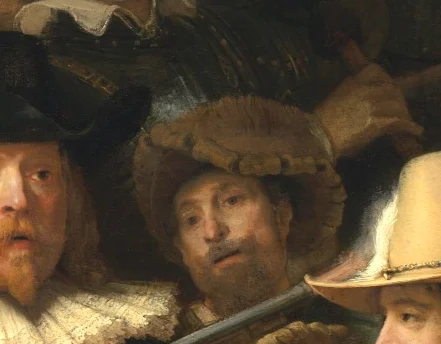
What you see
The crop shows the marked area in the original painting. Inspect its shapes, colours and position.
The project’s interpretation
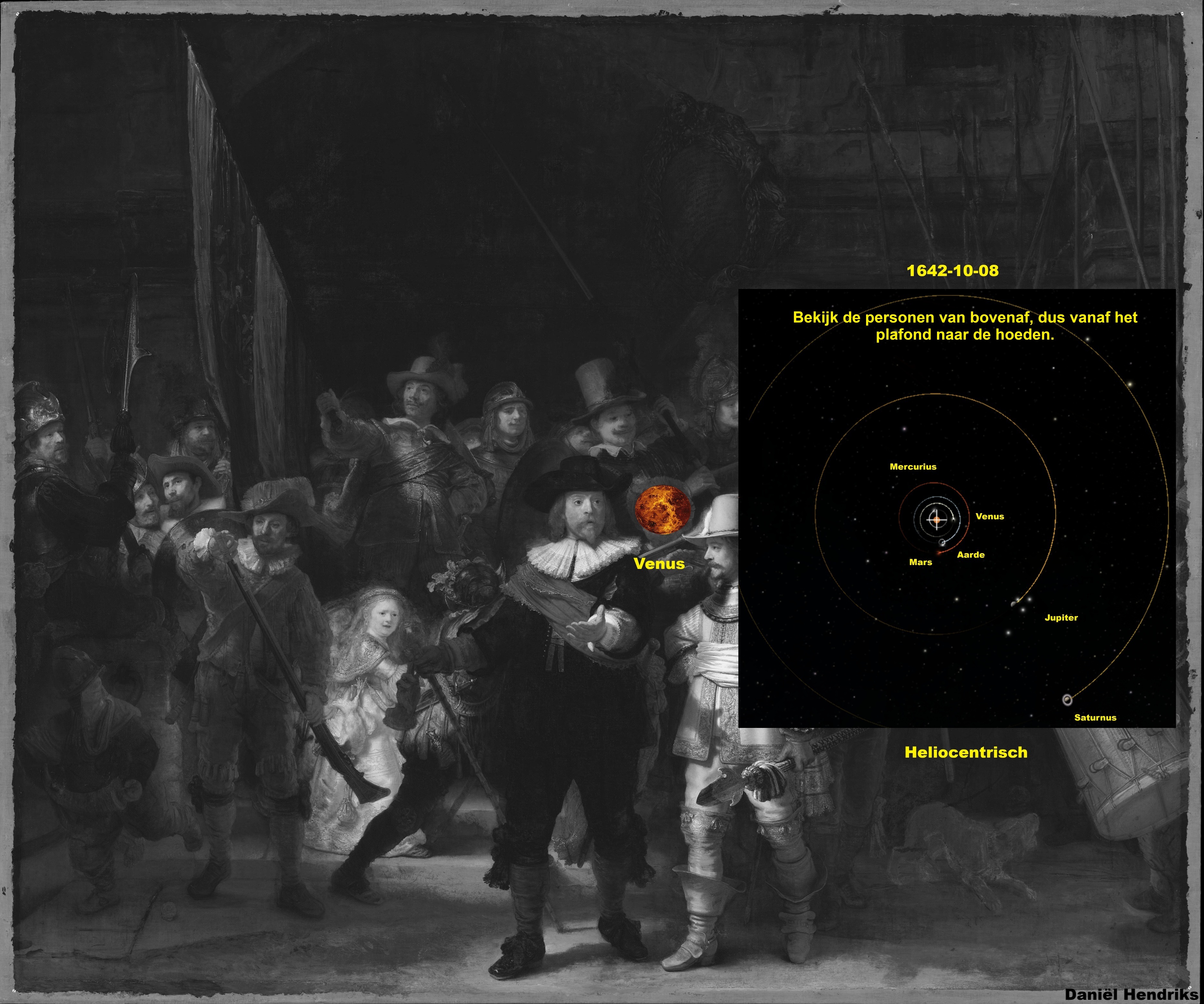
Venus (heliocentric) appears as the red-clad militiaman with a helmet who stands just to the right and slightly behind the white-uniformed lieutenant. Lay The Night Watch flat like a Copernican chart and a tidy inner-planet line emerges: Sun (Radiant Girl) → Mercury (blue boy) → Venus (red-armoured militiaman) → Earth (oak-leaf…
Compare for yourself
Use Compare to inspect the original and the project’s interpretation at the same scale.
Open the interactive painting →Full project notes
Venus (heliocentric) appears as the red-clad militiaman with a helmet who stands just to the right and slightly behind the white-uniformed lieutenant. Lay The Night Watch flat like a Copernican chart and a tidy inner-planet line emerges: Sun (Radiant Girl) → Mercury (blue boy) → Venus (red-armoured militiaman) → Earth (oak-leaf musketeer). This order places Venus exactly on her average orbit of 0.72 AU, between Mercury and Earth.
Colour & iconography
The deep carmine of his doublet echoes the fiery silver-pink glow with which Venus colours the twilight sky as the Morning Star or Evening Star. The mirror-like visor of his helmet catches a streak of lead-white—a subtle reference to the crescent phase Galileo sketched shortly before 1642.
Orbit & scale
The short distance between the militiaman and the Sun-Girl signals Venus’s tight path; the slight tilt of his rapier—about 3½°—matches Venus’s maximum orbital inclination to the ecliptic. Even that small deviation is rendered faithfully in paint.
Blaeu signature
Note the narrow ultramarine stripe where his red sash catches the light: together with the cobalt of the Mercury boy it forms the blue-red code by which Dr Joan Blaeu “signed” his design—a discreet colour duet marking the inner planets.
Detail to watch
Zoom in on the shining stud on his left glove: that single dab of lead-white sits at the exact ecliptic longitude where Venus stood during the Blood-Moon night—one pinpoint of paint as small as the planet itself in the real sky.
Sources and astronomical comparison
The interpretation on this page belongs to this project. The references below come from the notes. A Stellarium comparison shows the specified sky configuration; it is not, by itself, a historical source for Rembrandt’s intention.
View the astronomical comparison in Stellarium ↗
No separate source references have been added for this subject yet.
About the research and its authorTechnical data and coordinates
Stellarium data
| Property | Value |
|---|---|
| object | venus |
| dateTime | 1642-10-08T04:30:00Z |
| lat | 52.377956 |
| lng | 4.89707 |
| fov | 40 |
Coordinates on the Night Watch (3734 × 3113)
| Number | Coordinates |
|---|---|
| 1 | 1890, 1496 |
| 2 | 1951, 1645 |
| 3 | 2171, 1595 |
| 4 | 2112, 1461 |