planet
Venus (2)
What you see
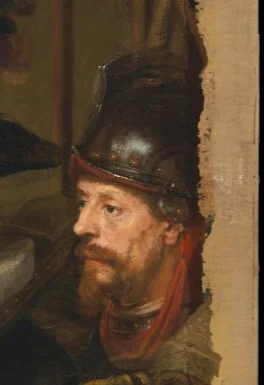
The crop shows the marked area in the original painting. Inspect its shapes, colours and position.
The project’s interpretation
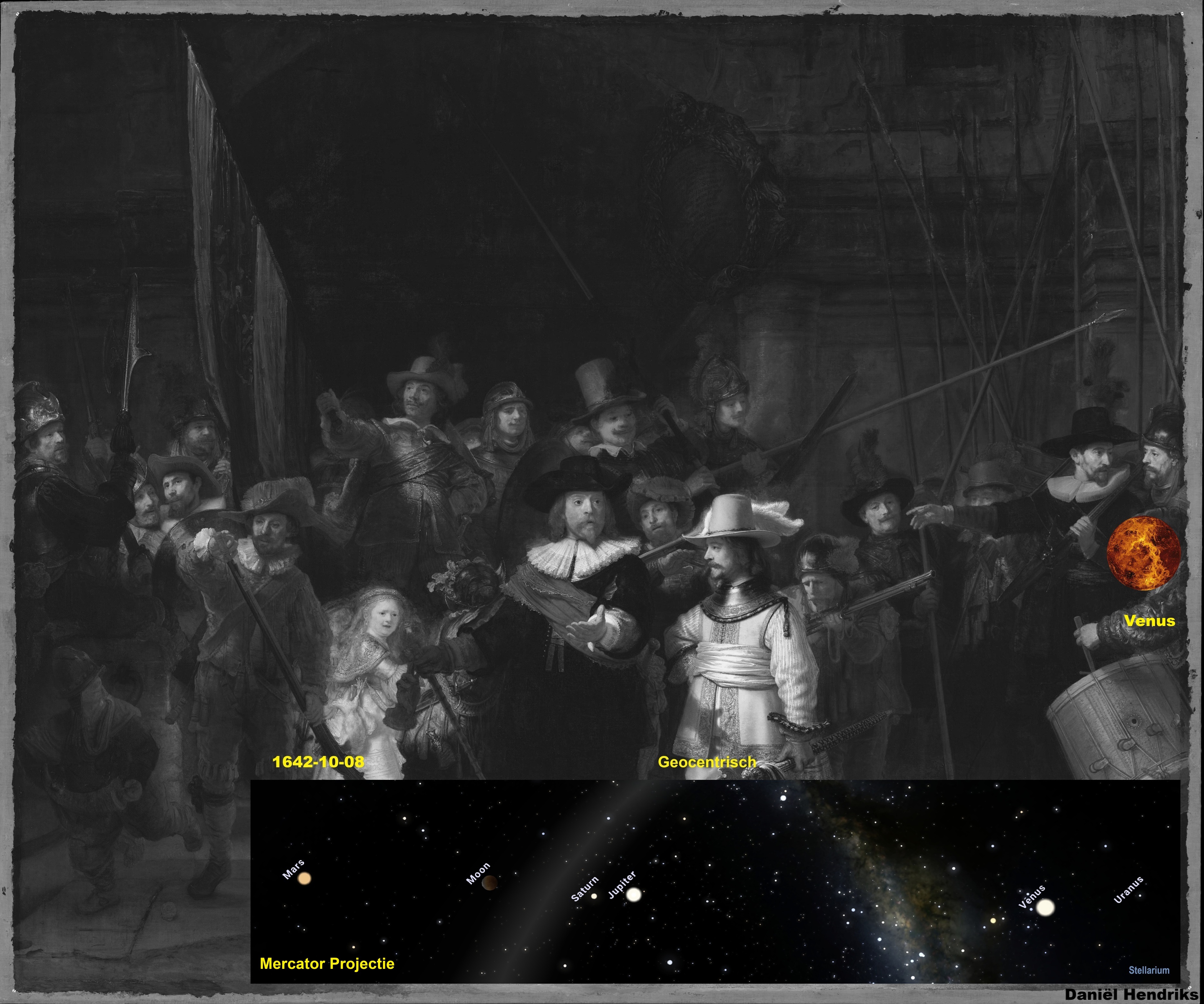
Venus takes shape in the geocentric section of The Night Watch as the right-flank militiaman with the red scarf and helmet. His conspicuous scarf—warm, lustrous red with a golden glint—mirrors the intense glow with which the planet blazed as the Morning Star just before sunrise. Geocentric view (Amsterdam, 8 October 1642, ± 05:30 local…
Compare for yourself
Use Compare to inspect the original and the project’s interpretation at the same scale.
Open the interactive painting →Full project notes
Venus takes shape in the geocentric section of The Night Watch as the right-flank militiaman with the red scarf and helmet. His conspicuous scarf—warm, lustrous red with a golden glint—mirrors the intense glow with which the planet blazed as the Morning Star just before sunrise.
Geocentric view (Amsterdam, 8 October 1642, ± 05:30 local time)
At the moment of the Blood Moon, Venus stood low in the east, scarcely six degrees from the Sun and therefore invisible in the growing twilight. To depict that without compressing the canvas’s scale, Rembrandt placed him all the way to the right of the Sun-figure Girl. Thus the sequence Sun → Venus remains correct—only one character apart—while giving the planet enough space to stand out. This lateral “sliding” prevents Venus from landing literally in the Sun, something unavoidable in a true sky projection.
Symbolism & attire
The red scarf alludes to the goddess of love and beauty, while also capturing the rosy hue the planet shows when it shines through a thick layer of air near the horizon. The high gleam on his helmet imitates the crescent phase: a narrow sliver of light along the edge represents the half-lit disc observers could see through the telescopes of the day.
Detail to watch
Zoom in on the tiny highlight on the lower hem of his scarf: that speck of lead white marks Venus’s actual elongation from the Sun during the Blood-Moon night, fitted exactly into the web of flag-ecliptic and musket-Earth-axis lines. A single brushstroke is enough to give the brightest planet its place in the sky and on the canvas.
Sources and astronomical comparison
The interpretation on this page belongs to this project. The references below come from the notes. A Stellarium comparison shows the specified sky configuration; it is not, by itself, a historical source for Rembrandt’s intention.
View the astronomical comparison in Stellarium ↗
No separate source references have been added for this subject yet.
About the research and its authorTechnical data and coordinates
Stellarium data
| Property | Value |
|---|---|
| object | venus |
| dateTime | 1642-10-08T04:30:00Z |
| lat | 52.377956 |
| lng | 4.89707 |
| fov | 40 |
Coordinates on the Night Watch (3734 × 3113)
| Number | Coordinates |
|---|---|
| 1 | 3550, 1280 |
| 2 | 3550, 1505 |
| 3 | 3660, 1505 |
| 4 | 3660, 1280 |