constellation
Great Bear (UMa)

What you see
The crop shows the marked area in the original painting. Inspect its shapes, colours and position.
The project’s interpretation
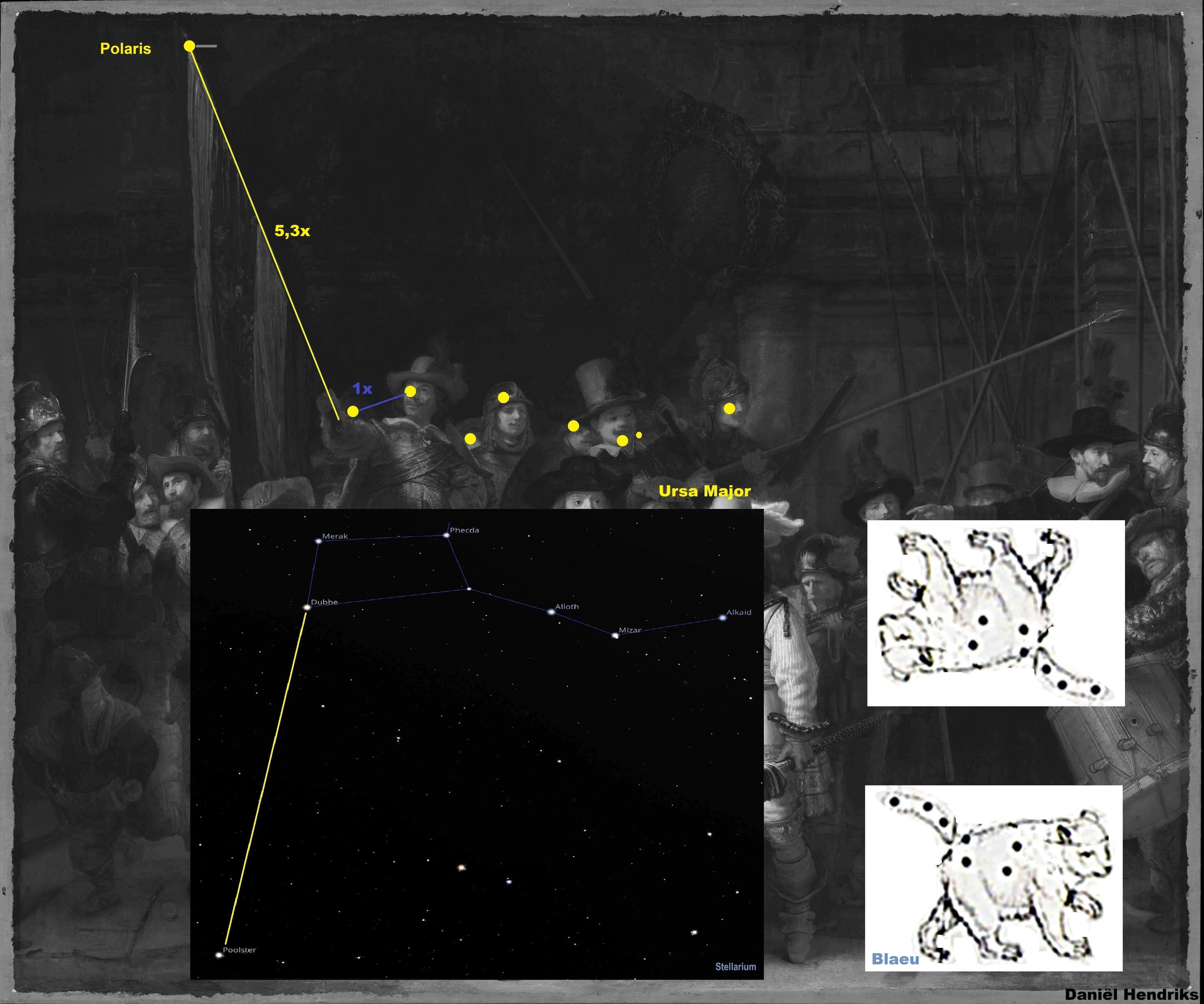
Great Bear (Ursa Major) is concealed in The Night Watch within the back row of eight musketeers. Lay the canvas flat and look down on it: their helmets and pauldrons trace the Big Dipper, but upside-down—exactly as the constellation appeared above Amsterdam at sunrise on 8 October 1642. Orientation & overhead view The figures stand at an…
Compare for yourself
Use Compare to inspect the original and the project’s interpretation at the same scale.
Open the interactive painting →Full project notes
Great Bear (Ursa Major) is concealed in The Night Watch within the back row of eight musketeers. Lay the canvas flat and look down on it: their helmets and pauldrons trace the Big Dipper, but upside-down—exactly as the constellation appeared above Amsterdam at sunrise on 8 October 1642.
Orientation & overhead view
The figures stand at an angle of 23½° to the flag diagonal (the ecliptic tilt), so the “ladle” swings with Earth’s axis. The second musketeer from the right is notably smaller; together with his neighbour he forms the Mizar–Alcor pair, the famous double star midway along the handle.
Toward Polaris
Follow the two left-most “stars” (Dubhe and Merak) in a straight line and you arrive at the tiny highlight on the tip of the flagstaff, marked by a black stroke—Polaris. Because the flag itself is aligned exactly with Earth’s axis, Ursa Major functions as a perfectly calibrated compass inside the composition.
Geometric discovery
On the canvas the distance between those two left-hand stars and the Pole Star measures 59 Dutch inches, while the distance between the two stars themselves is 11 inches—a 59 : 11 ratio that matches almost exactly the real 5.3 : 1 spacing on the celestial sphere. Rembrandt/Blaeu thus recorded not only the direction but also the scale in paint.
Detail to watch
Zoom in on the tiny gleam on the smallest helmet (Mizar–Alcor): there you’ll find a double dab of lead white, a subtle hint that two stars hide in a single “point”—a wink toward telescopes yet to be built.
Sources and astronomical comparison
The interpretation on this page belongs to this project. The references below come from the notes. A Stellarium comparison shows the specified sky configuration; it is not, by itself, a historical source for Rembrandt’s intention.
View the astronomical comparison in Stellarium ↗
No separate source references have been added for this subject yet.
About the research and its authorTechnical data and coordinates
Stellarium data
| Property | Value |
|---|---|
| object | ursamajor |
| dateTime | 1642-10-08T04:30:00Z |
| lat | 52.377956 |
| lng | 4.89707 |
| fov | 40 |
Coordinates on the Night Watch (3734 × 3113)
| Number | Coordinates |
|---|---|
| 1 | 1040, 1100 |
| 2 | 1040, 1410 |
| 3 | 2360, 1410 |
| 4 | 2360, 1100 |