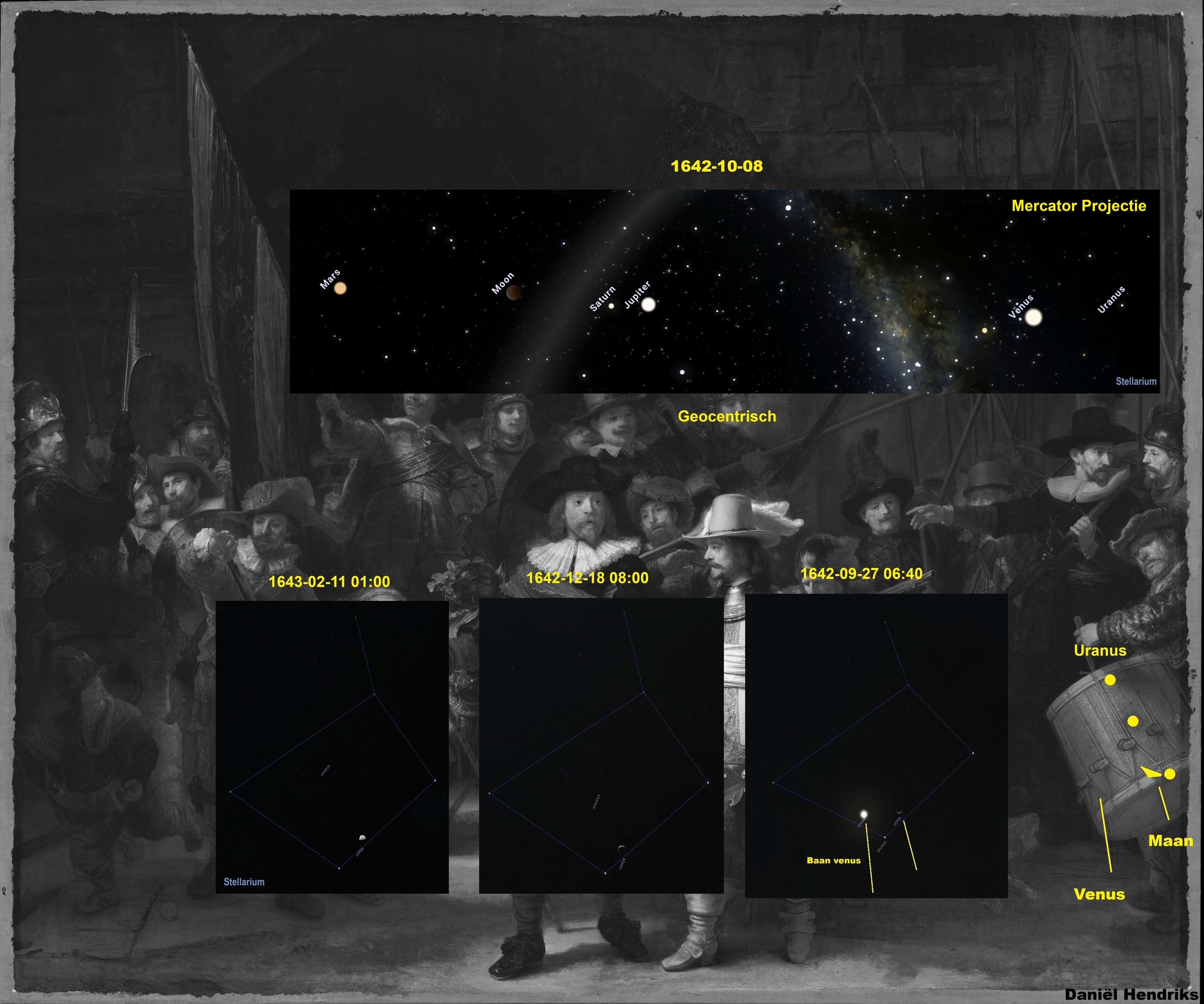
planet
Uranus (7)
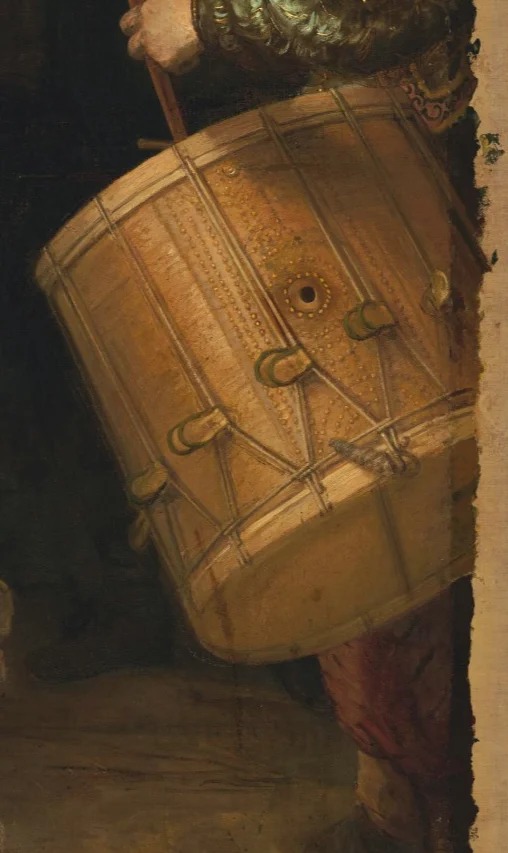
What you see
This selection shows details of the drum, including dark patches and slanting marks.
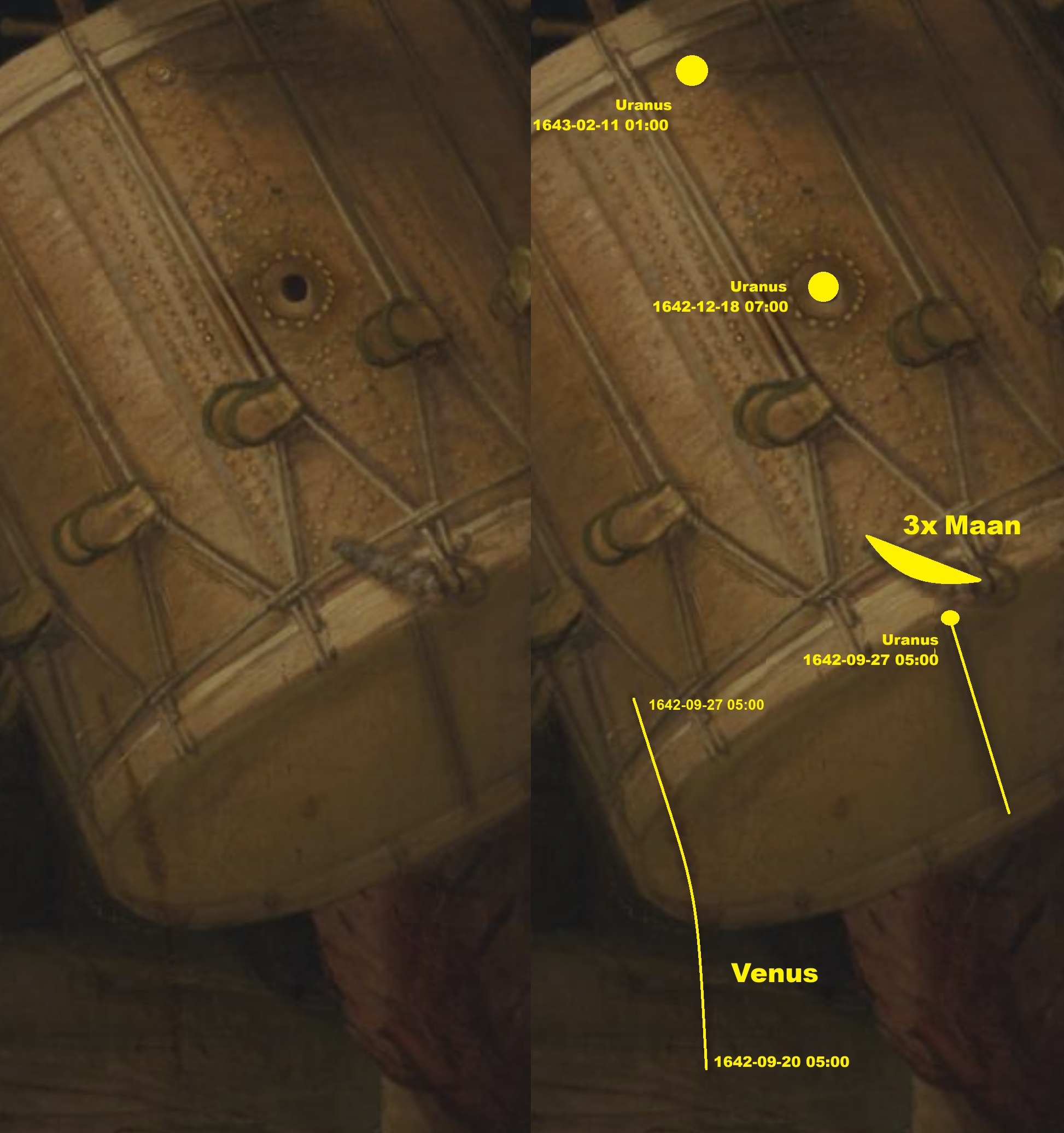
The project’s interpretation
The project proposes reading these marks as different positions of Uranus. The full notes explain the reasoning.
Compare for yourself
Inspect the crop and compare the dated Stellarium views linked in the full notes.
Open the interactive painting →Full project notes
Uranus in The Night Watch
Uranus was not yet an “official” planet in 1642—it would only receive that status in 1781—but in the drum (constellation Libra) of the Night Watch it is recorded with surprising precision. The large sound hole (and a second, smaller one) act as windows onto a discovery that would not appear in star catalogues until a century and a half later.
Heliocentric (three snapshots)
- : Uranus is just outside the edge of Libra; the Moon and Venus slide in from the lower right. In the paint this shows up as the two slanted drum stripes beneath the skin. Stellarium
- : The Moon is in the same position, but Uranus now sits in the middle of the drum— represented by the large hole in the skin. Stellarium
- : The Moon repeats its position; Uranus has moved ahead and appears as the small hole just at the top of the skin, after which it will reverse. Stellarium
Together the three holes and stripes create a miniature “time-lapse” of Uranus’s slow, 84-year orbit around the Sun, clearly visible when you lay the canvas flat as a Copernican chart. See the image below:
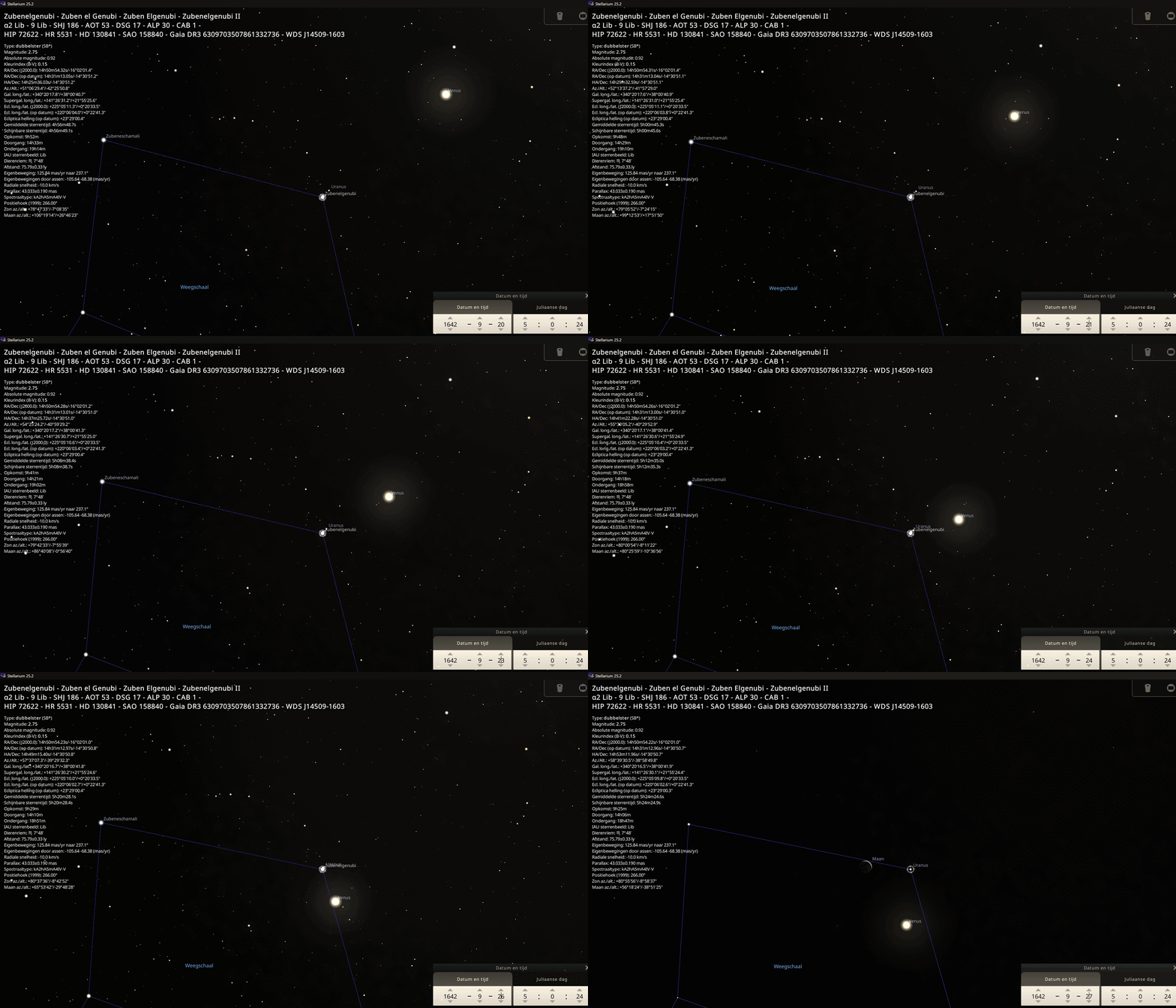
The moving trace below shows how Venus, accompanied by the Moon and Uranus, enters the constellation Libra—a celestial choreography captured in light.
Geocentric (frontal view)
When you view the painting straight on, the large hole coincides with Uranus’s apparent position relative to the other planets on the Blood-Moon night. Even though Uranus was unknown in 1642, the alignment matches modern celestial coordinates to within a degree. See also the image at the very bottom.
Blaeu’s hidden hand
The fact that an “undiscovered” planet is consistently marked on three different dates points to the involvement of Dr Joan Blaeu. The drum stripes follow the exact angle of the ecliptic and repeat measurement points from his Atlas Maior. What looked like a mere drumstroke to a 17th-century viewer turns out to be a subtle astronomical note. All in all, it shows that well before 1642—the year the Night Watch was delivered—Uranus was already fully known as a planet.
Detail to watch for
Zoom in on the brass tension sleeve to the left of the large hole: there you’ll find a tiny dab of lead-white paint marking Uranus’s ecliptic longitude on . One speck of paint that anticipated three centuries of science.
Sources and astronomical comparison
The interpretation on this page belongs to this project. The references below come from the notes. A Stellarium comparison shows the specified sky configuration; it is not, by itself, a historical source for Rembrandt’s intention.
About the research and its authorTechnical data and coordinates
Stellarium data
| Property | Value |
|---|---|
| object | uranus |
| dateTime | 1642-09-27T06:26:00Z |
| lat | 52.377956 |
| lng | 4.89707 |
| fov | 40 |
Coordinates on the Night Watch (3734 × 3113)
| Number | Coordinates |
|---|---|
| 1 | 3290, 2060 |
| 2 | 3419, 2715 |
| 3 | 3638, 2580 |
| 4 | 3500, 2022 |