zodiac
Taurus (Tau)
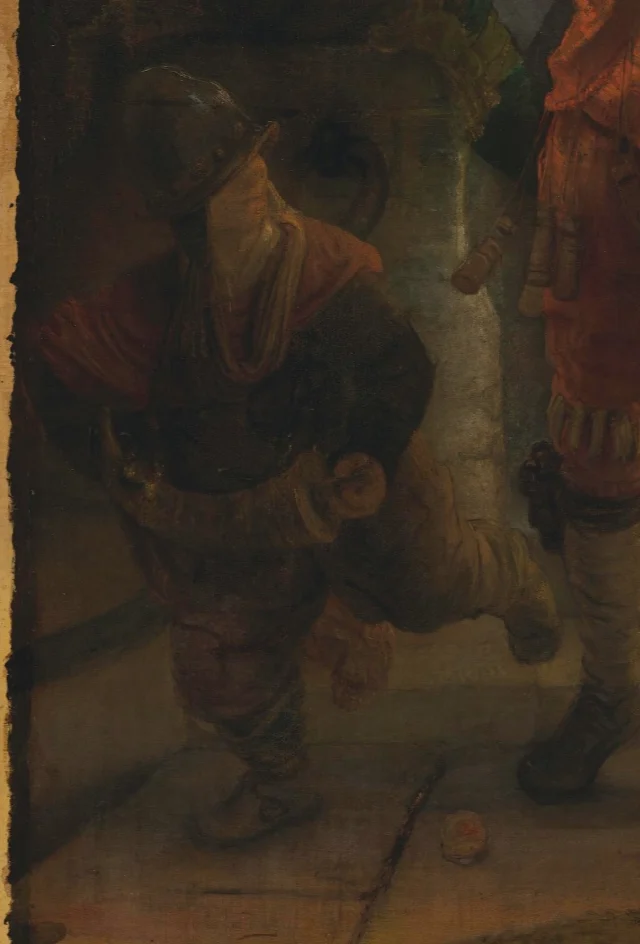
What you see
The crop shows the marked area in the original painting. Inspect its shapes, colours and position.
The project’s interpretation
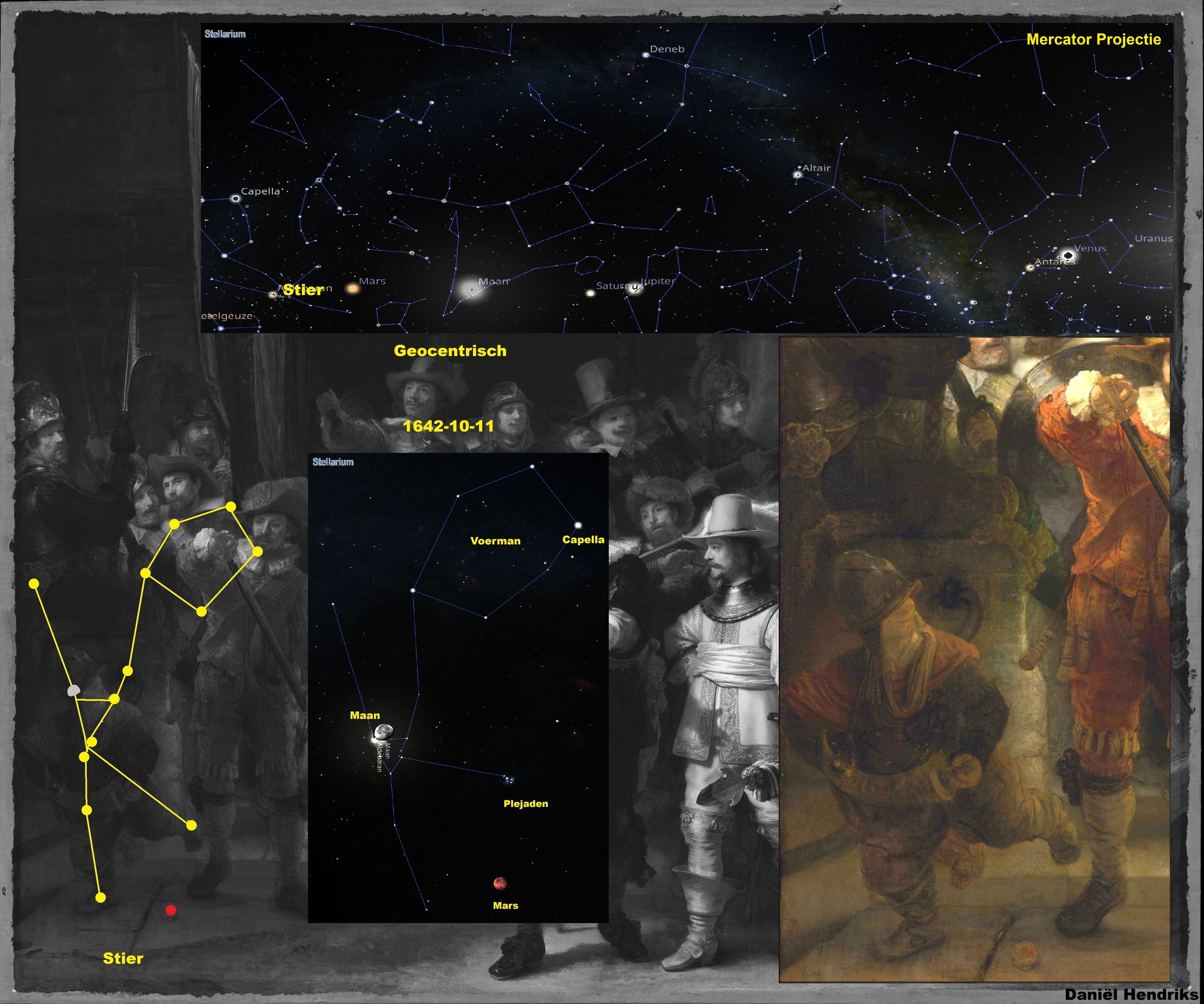
Taurus emerges in The Night Watch as the musketeer in the lower left holding a drinking horn. Lay the canvas flat and view it from above: his two legs outline the long V-shape of the Hyades, while the up-tilted horn traces the curved “upper-left horn” of Taurus. Geocentric · 8 October 1642 05:30 During the Blood Moon, Taurus hung low in…
Compare for yourself
Use Compare to inspect the original and the project’s interpretation at the same scale.
Open the interactive painting →Full project notes
Taurus emerges in The Night Watch as the musketeer in the lower left holding a drinking horn. Lay the canvas flat and view it from above: his two legs outline the long V-shape of the Hyades, while the up-tilted horn traces the curved “upper-left horn” of Taurus.
Geocentric · 8 October 1642 05:30
During the Blood Moon, Taurus hung low in the east-southeast; Mars was then crawling through the Hyades, right beside the chief star Aldebaran. Rembrandt/Blaeu captured that by painting a small red-brown rosette between the musketeer’s knees—an extra “planet-knot” that belongs to no uniform yet lands astronomically exactly on Mars’s position.
Pleiades as a shoe tip
Look at his left shoe (on the viewer’s right): the shiny leather tuft on the toe bears seven microscopic brush dots. Those are the Pleiades, the compact star cluster that in 1642 shone a hand’s breadth above Mars. Thus the Hyades and Pleiades—Taurus’s two main markers—sit close together, just as in the sky.
Symbolic harmony
The drinking horn recalls the classical “Oxo Horn” with which Taurus was drawn on old star maps. Because Mars passed through the Hyades in 1642, the rosette becomes a red bull’s eye underscoring the celestial event. One figure therefore embodies constellation, planet, and mythic attribute in a single gesture.
Detail to watch
Zoom in on the pale highlight along the horn’s shaft: that brushstroke follows the 5° angle at which Taurus’s eastern horn met the horizon that morning—a tiny but measurable reminder of the stars’ true positions.
Sources and astronomical comparison
The interpretation on this page belongs to this project. The references below come from the notes. A Stellarium comparison shows the specified sky configuration; it is not, by itself, a historical source for Rembrandt’s intention.
View the astronomical comparison in Stellarium ↗
No separate source references have been added for this subject yet.
About the research and its authorTechnical data and coordinates
Stellarium data
| Property | Value |
|---|---|
| object | taurus |
| dateTime | 1642-10-08T04:30:00Z |
| lat | 52.377956 |
| lng | 4.89707 |
| fov | 40 |
Coordinates on the Night Watch (3734 × 3113)
| Number | Coordinates |
|---|---|
| 1 | 119, 2013 |
| 2 | 110, 2417 |
| 3 | 244, 2841 |
| 4 | 557, 2861 |
| 5 | 633, 2557 |
| 6 | 335, 2057 |