central star
Sun and the Moon
What you see
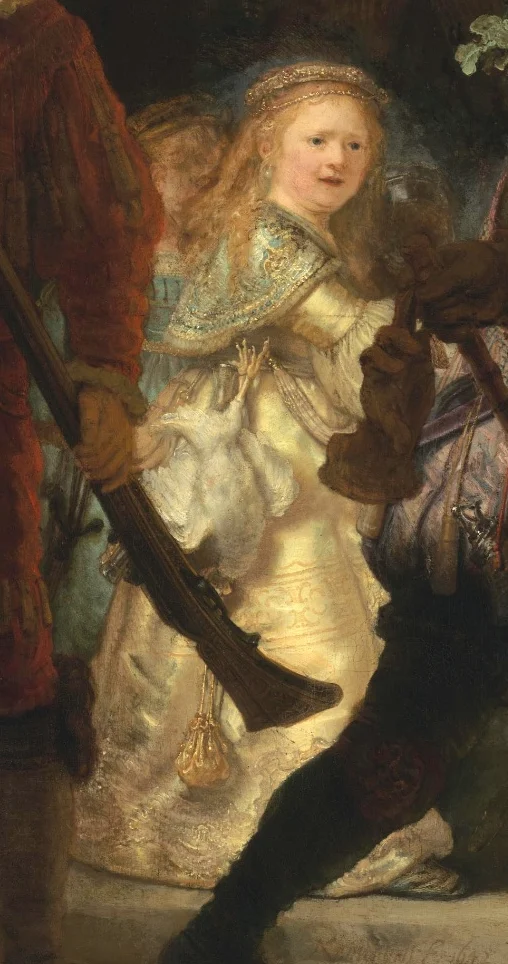
The brightly lit girl stands out among the militiamen.
The project’s interpretation
The project associates this figure with the Sun and Moon and examines her position relative to other figures.
Compare for yourself
First look at the light and the position of the figure. Then use Compare to inspect the astronomical interpretation.
Open the interactive painting →Full project notes
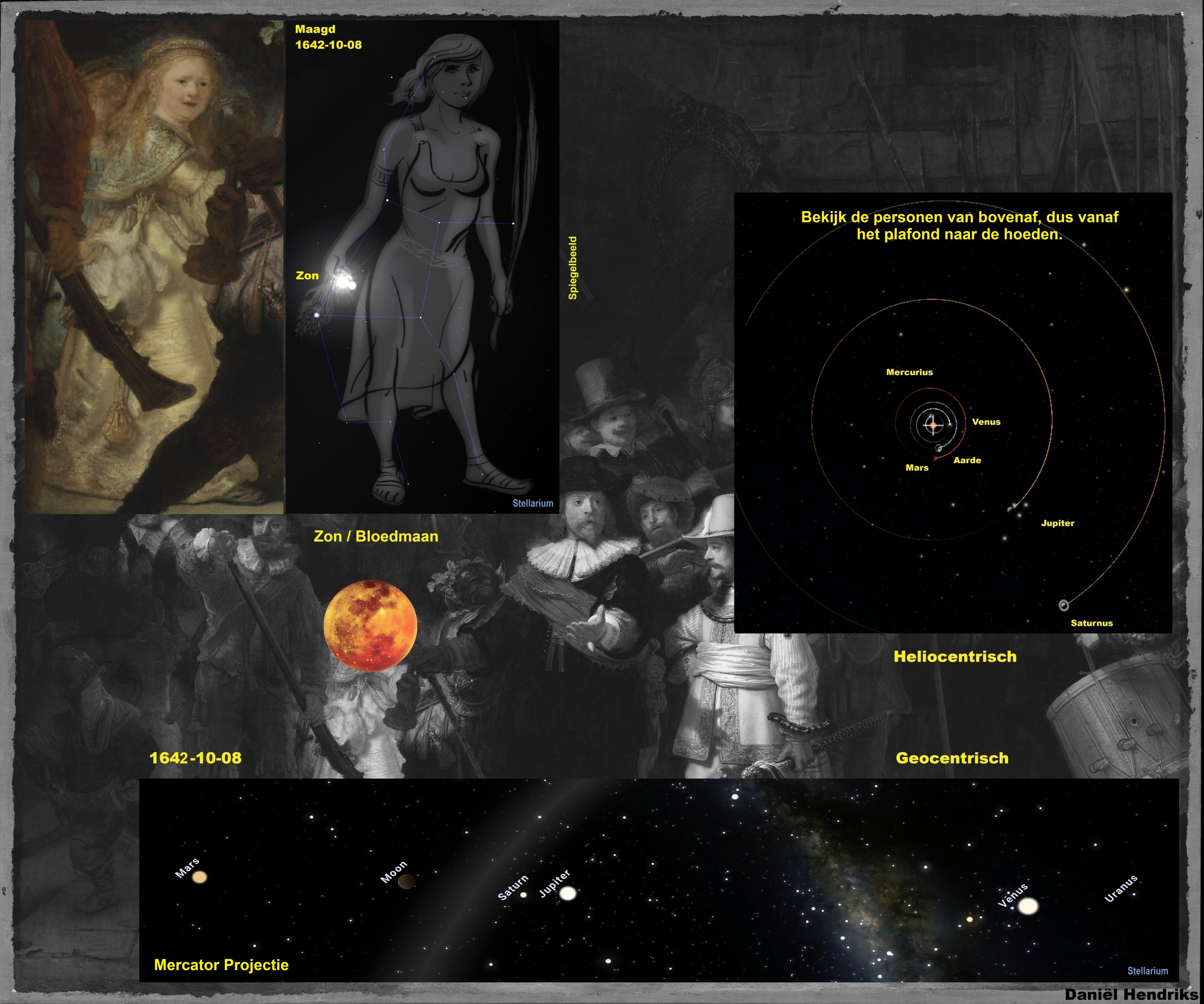
The Radiant Girl acts as the pivot of Rembrandt’s cosmic tableau. She not only gleams as the Sun-like centre of the painting, she also incarnates the eclipsed Blood Moon of 8 October 1642—a rare case in which one figure is simultaneously correct in both heliocentric and geocentric terms.
Heliocentric view (seen from above)
Imagine The Night Watch flattened into a star chart and look down on it: the girl stands exactly where the Sun belongs—at the centre of the Earth-Moon-planet alignment. Around her the militiamen form concentric rings that simulate the orbits from Mercury to Saturn; their halberds, lances, and muskets point toward the actual planetary positions on that morning. Because, in this overhead view, the Moon slips behind Earth, the Blood Moon is not personified; instead it appears as the deep-red sash streaming behind Captain Frans Banning Cocq. Thus the sequence Sun (girl) – Earth (the man with oak leaves on his helmet) – Moon (red band) lies perfectly in line.
Geocentric view (at street level)
Step back to the façade and look horizontally: now the girl becomes the full Moon that turned blood-red in Earth’s shadow during the eclipse. The warm glow on her cheeks and the dark edge in the fold of her skirt mirror that coppery light. The surrounding men—read here as the planets—stand as spectators around the darkened disc, each occupying the position in which he would have appeared on the celestial dome.
The crowing rooster
A plucked rooster dangles from her belt; its symbolic morning crow signals the sunrise that ended totality. While the Blood Moon set westward, the first daylight broke beyond the city moat—a subtle nod to the cyclical rebirth of light.
Double-perspective trick
By letting one figure “tilt” between Sun and Moon, Rembrandt shows that both models—Copernican and traditional geocentric—can be correct at the same time, provided you change your vantage point. The viewer thus gains a built-in planetarium: drift mentally upward and you see the solar system from above; descend again and you see an eclipsing Moon at the heart of an Amsterdam militia company.
Detail to watch
Zoom in on the brightest sparkle on her brooch: that minuscule dab of lead white marks precisely where the ecliptic crosses the canvas’s mid-line. There the heliocentric and geocentric models meet—a glint of paint at the crossroads of two worlds.
Sources and astronomical comparison
The interpretation on this page belongs to this project. The references below come from the notes. A Stellarium comparison shows the specified sky configuration; it is not, by itself, a historical source for Rembrandt’s intention.
View the astronomical comparison in Stellarium ↗
No separate source references have been added for this subject yet.
About the research and its authorTechnical data and coordinates
Stellarium data
| Property | Value |
|---|---|
| object | moon |
| dateTime | 1642-10-08T04:30:00Z |
| lat | 52.377956 |
| lng | 4.89707 |
| fov | 40 |
Coordinates on the Night Watch (3734 × 3113)
Region 1
| Number | Coordinates |
|---|---|
| 1 | 1121, 1841 |
| 2 | 1001, 2367 |
| 3 | 1276, 2361 |
| 4 | 1240, 1860 |
Region 2
| Number | Coordinates |
|---|---|
| 1 | 993, 2373 |
| 2 | 949, 2604 |
| 3 | 1297, 2645 |
| 4 | 1270, 2358 |