line
Summer and Winter Solstice
What you see
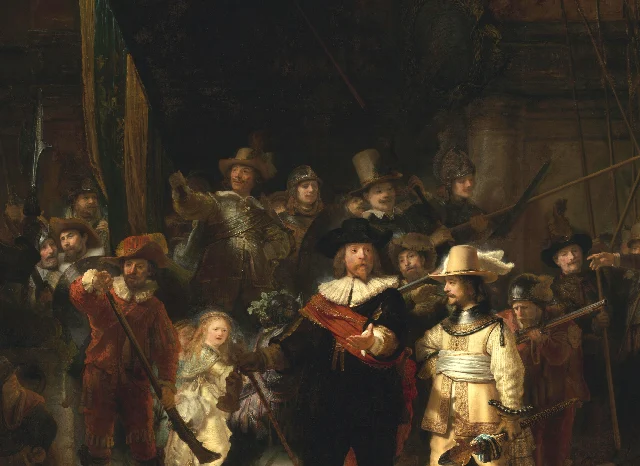
The crop shows the marked area in the original painting. Inspect its shapes, colours and position.
The project’s interpretation
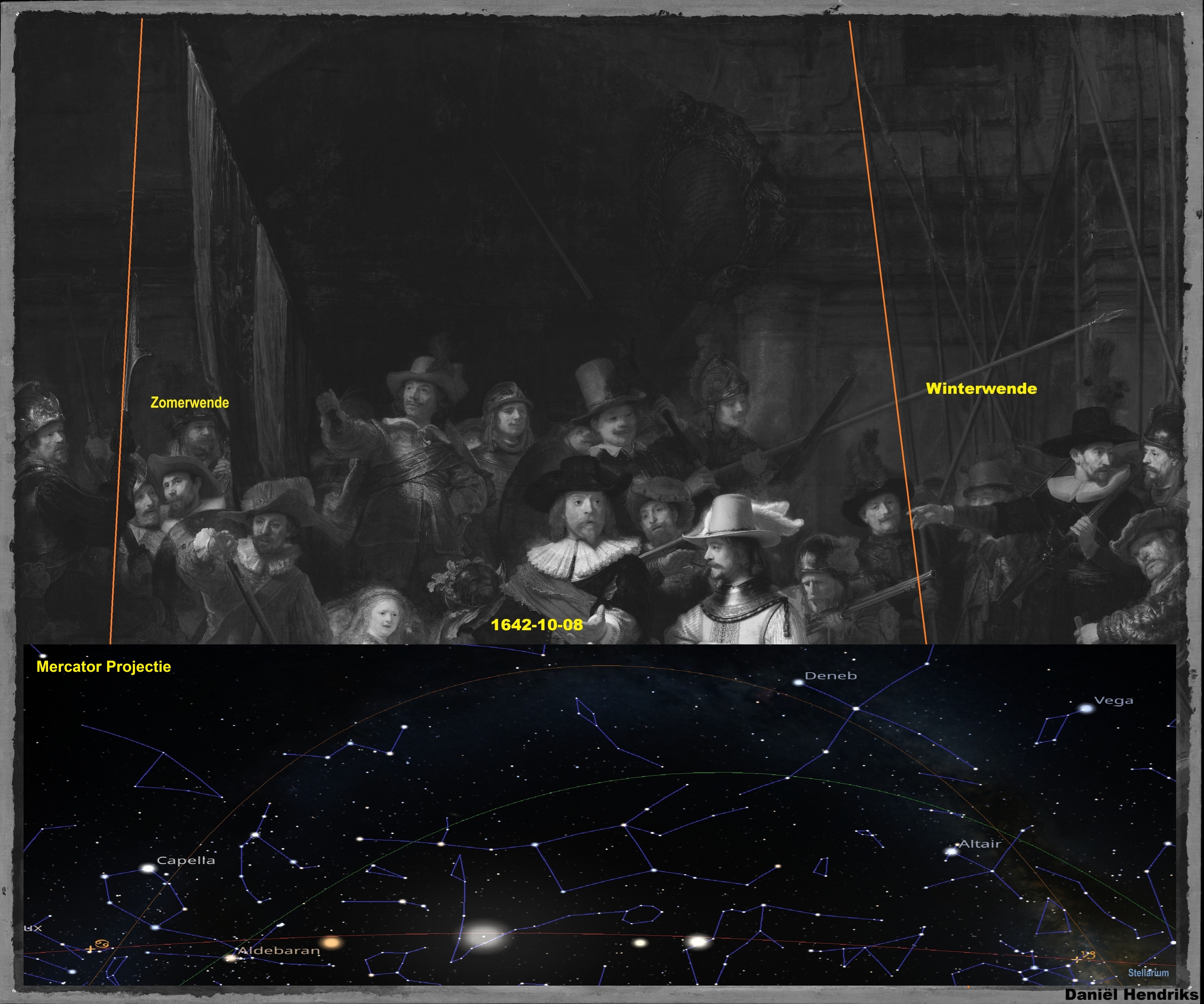
Summer and Winter Solstice are pinned down in The Night Watch by two long weapons that, when the canvas is laid flat, mark the Sun’s extreme positions during the year. Summer Solstice · 21 June 1642 The spear-and-sword hoisted by the blue Mercury boy points to the highest spot the Sun reached that year (about + 23½° above the ecliptic…
Compare for yourself
Use Compare to inspect the original and the project’s interpretation at the same scale.
Open the interactive painting →Full project notes
Summer and Winter Solstice are pinned down in The Night Watch by two long weapons that, when the canvas is laid flat, mark the Sun’s extreme positions during the year.
Summer Solstice · 21 June 1642
The spear-and-sword hoisted by the blue Mercury boy points to the highest spot the Sun reached that year (about + 23½° above the ecliptic mid-line). The blade cuts the flag/Earth-axis exactly where the Tropic of Cancer lies on Blaeu’s maps. Because the Blood-Moon night of 8 October 1642 fell several months after the solstice, the spear sits a little behind the Sun-figure Girl—a reminder that the Sun was already heading south again.
Winter Solstice · 21 December 1642
At the far right a long, slender spear first crosses the collar of the big dog (Canis Major / Wolf) and then touches the outstretched hand—Antares—of the Scorpius musketeer. That line points – 23½° below the ecliptic and marks the Tropic of Capricorn, giving the winter solstice a tangible anchor on the canvas.
Why on a Blood-Moon night?
During the eclipse of 8 October 1642, the Sun stood exactly opposite the darkened Moon. By placing both solstice spears in a single picture plane, Blaeu shows where Earth’s axis (flag), the ecliptic (flag-to-musket diagonal), and the Sun’s extreme paths intersect. The painting thus acts as a cosmic calendar: look left for midsummer, right for midwinter, and centre-stage for the Moon that provides the measuring moment.
Detail to watch
Zoom in on the tiny lead-white dot on the spearpoint beside Mercury: that is Blaeu’s mark for the Sun on 21 June. On the winter spear you’ll find, level with Antares’s fingertip, a second dot—the Sun’s position on 21 December. Two pinheads of paint capture an entire solar year.
Sources and astronomical comparison
The interpretation on this page belongs to this project. The references below come from the notes. A Stellarium comparison shows the specified sky configuration; it is not, by itself, a historical source for Rembrandt’s intention.
No separate source references have been added for this subject yet.
About the research and its authorTechnical data and coordinates
Coordinates on the Night Watch (3734 × 3113)
Region 1
| Number | Coordinates |
|---|---|
| 1 | 399, 830 |
| 2 | 323, 1701 |
| 3 | 376, 1718 |
| 4 | 443, 850 |
Region 2
| Number | Coordinates |
|---|---|
| 1 | 2697, 540 |
| 2 | 2930, 2423 |
| 3 | 2966, 2423 |
| 4 | 2738, 546 |