event
Solar Eclipse
What you see
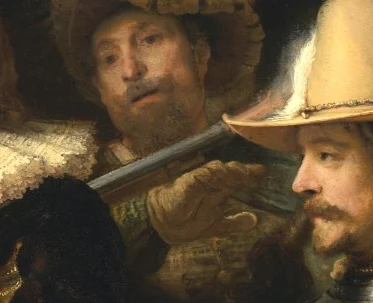
The crop shows the marked area in the original painting. Inspect its shapes, colours and position.
The project’s interpretation
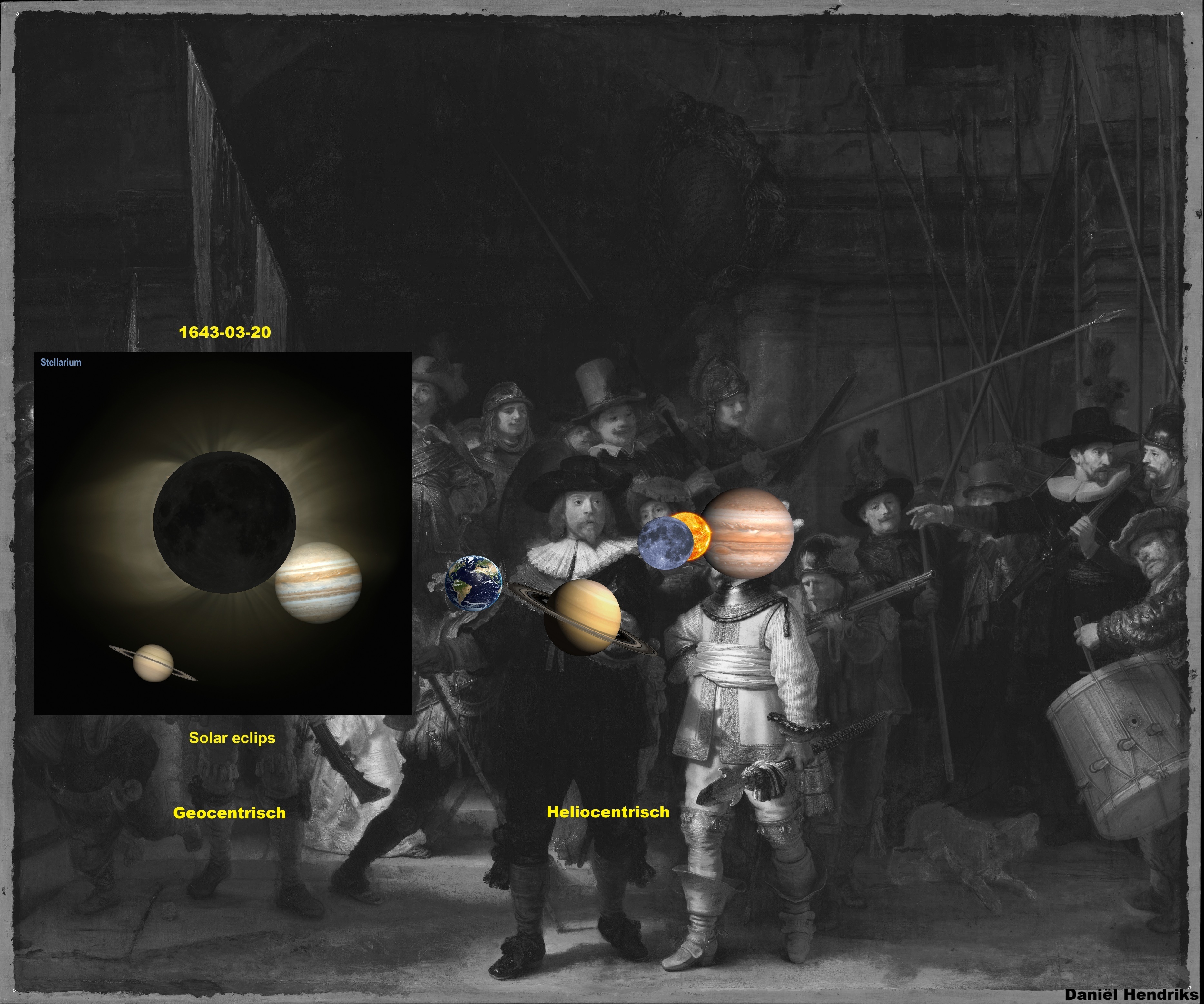
Solar Eclipse 20 March 1643—EXACTLY on the vernal equinox—was the most charged celestial event of Rembrandt’s day. That morning the Moon slid squarely in front of the Sun, dragging its shadow across the Pacific Ocean; in Amsterdam the phenomenon was merely predicted (and invisible), yet it was calculated and discussed by cartographers…
Compare for yourself
Use Compare to inspect the original and the project’s interpretation at the same scale.
Open the interactive painting →Full project notes
Solar Eclipse 20 March 1643—EXACTLY on the vernal equinox—was the most charged celestial event of Rembrandt’s day. That morning the Moon slid squarely in front of the Sun, dragging its shadow across the Pacific Ocean; in Amsterdam the phenomenon was merely predicted (and invisible), yet it was calculated and discussed by cartographers such as Joan Blaeu.
Heliocentric straight shot
Measured from the centre of the solar system, five bodies stood almost in a single file on 20-03-1643: Earth – Moon – Sun – Jupiter – Saturn. The line-up resulted from Jupiter and Saturn having met in their great conjunction of 24 February 1643 barely four weeks earlier. In Rembrandt’s canvas that cosmic “bullet trajectory” is rendered literally as the musket shot: the brilliant muzzle flash is the Sun, the barrel represents the Moon’s shadow, while the projectile itself strikes where Jupiter sits and Saturn follows as the “invisible rear guard.”
Geocentric viewpoint
To observers on Earth the order was reversed: the Sun was briefly quenched, while Jupiter and Saturn lay behind it and disappeared in the blinding corona. That effect returns in The Night Watch: the whitish smoke veil around the barrel acts as the eclipsed corona, while the darker powder cloud suggests the lunar disc.
Symbolism in the composition
The shot links the left panel—where Saturn figures—to the centre where Jupiter is “hit.” In a single brushstroke Rembrandt bridges planetary mechanics and military drama. The glowing rim around the flash even matches the 23½° tilt of the ecliptic, letting the viewer intuitively perceive the direction of the alignment.
Detail to watch
Zoom in on the tiniest spark flying just ahead of the powder cloud—that speck marks the exact crossing point of the ecliptic with the musket’s path and thus the optical location of the Moon at totality. Spot it, and you can almost hear the thunderous echo with which Rembrandt blasted the heavens onto his canvas.
Sources and astronomical comparison
The interpretation on this page belongs to this project. The references below come from the notes. A Stellarium comparison shows the specified sky configuration; it is not, by itself, a historical source for Rembrandt’s intention.
View the astronomical comparison in Stellarium ↗
No separate source references have been added for this subject yet.
About the research and its authorTechnical data and coordinates
Stellarium data
| Property | Value |
|---|---|
| object | sun |
| dateTime | 1643-03-20T02:00:00Z |
| lat | 52.377956 |
| lng | 4.89707 |
| fov | 40 |
Coordinates on the Night Watch (3734 × 3113)
| Number | Coordinates |
|---|---|
| 1 | 1972, 1698 |
| 2 | 1981, 1765 |
| 3 | 2173, 1727 |
| 4 | 2185, 1622 |