zodiac
Scorpius (Sco)
What you see
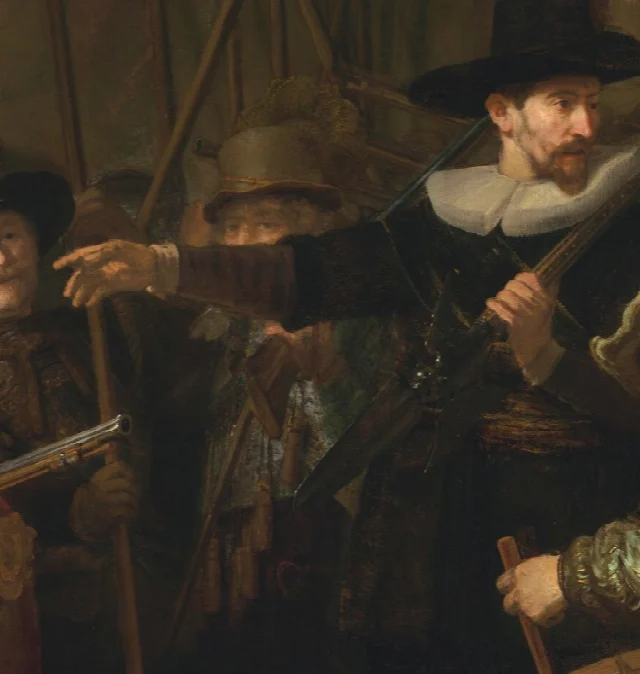
The crop shows the marked area in the original painting. Inspect its shapes, colours and position.
The project’s interpretation
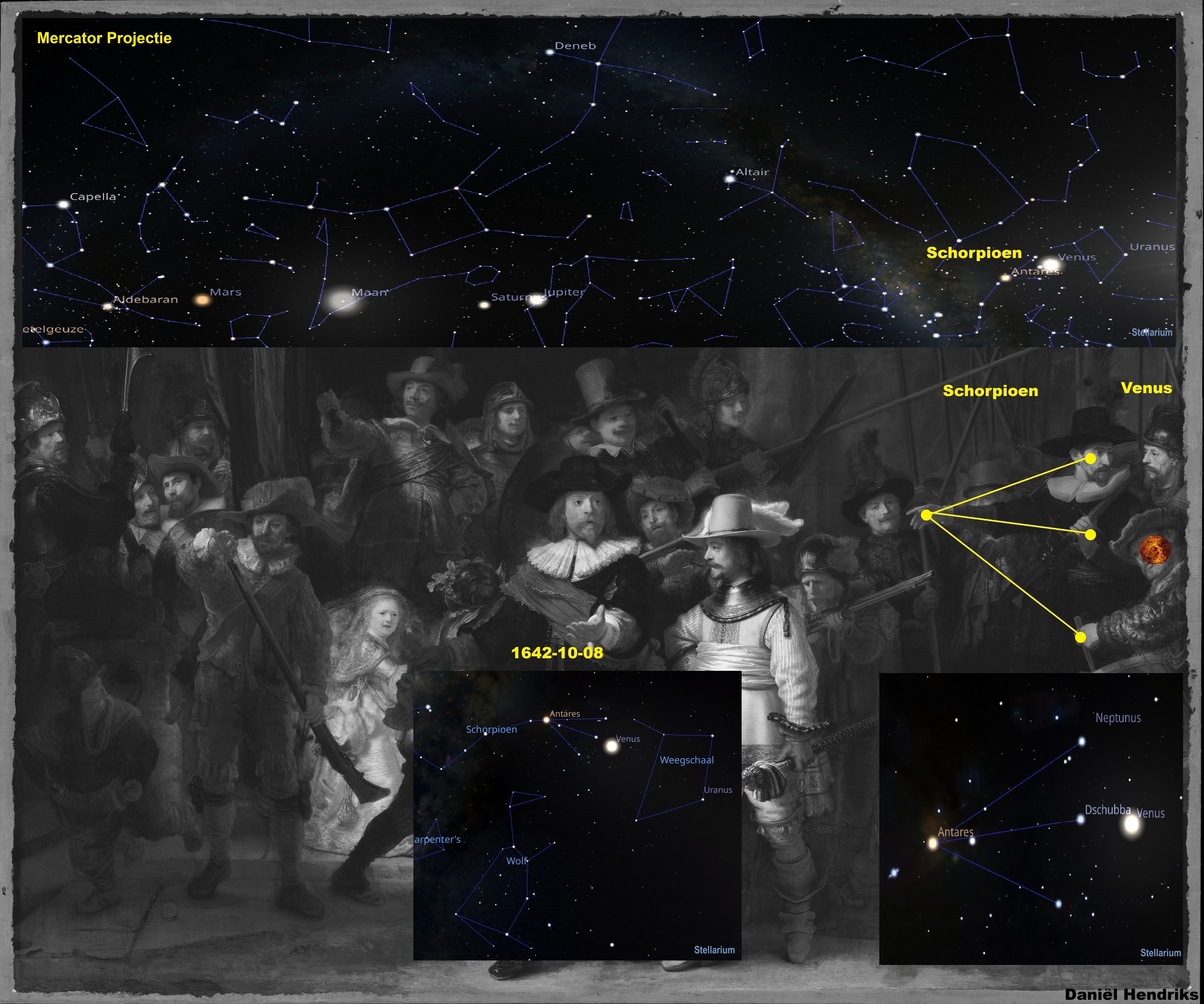
Scorpius hides in The Night Watch as the right-flank musketeer with the black hat. On the Blood-Moon night (8 October 1642, ± 05:30 local time) the constellation sat low in the south-south-west; Rembrandt/Blaeu tilted that projection onto the canvas so that the scorpion appears directly above the wolf (the resting dog) and the drum.…
Compare for yourself
Use Compare to inspect the original and the project’s interpretation at the same scale.
Open the interactive painting →Full project notes
Scorpius hides in The Night Watch as the right-flank musketeer with the black hat. On the Blood-Moon night (8 October 1642, ± 05:30 local time) the constellation sat low in the south-south-west; Rembrandt/Blaeu tilted that projection onto the canvas so that the scorpion appears directly above the wolf (the resting dog) and the drum.
Star-by-star translation
- Antares (α Sco) — the fiery heart of the scorpion becomes the musketeer’s outstretched right hand, tipped with a bright brush-highlight on the fingertip.
- Dschubba (δ Sco) — his face; the shadow beneath the hat-brim hints at the star’s double nature.
- Sargas (θ Sco) — the left hand pointing at the musket stocks; a second glint marks the star’s slightly weaker magnitude.
- Shaula (λ Sco) — the hand of the drum-bearer; even the tail-stinger finds its place on the canvas.
Venus + Wolf association
To the right of Antares, Venus gleams as a bright spot on the helmet rim of the adjoining musketeer—just as the planet stood a few degrees east of Scorpius in 1642. Beneath the drum lies the large dog; in this context it can also be read as the constellation Lupus (The Wolf), which old star maps place beneath Scorpius. Thus the composition matches the real sky right down to star-chart level.
Detail to watch
Zoom in on the red dab of paint on Antares’s “fingernail”: the pigment contains extra vermilion to capture the supergiant’s orange-red hue—a refined nuance proving that the extended hand is no coincidence but an astronomical anchor point.
Sources and astronomical comparison
The interpretation on this page belongs to this project. The references below come from the notes. A Stellarium comparison shows the specified sky configuration; it is not, by itself, a historical source for Rembrandt’s intention.
View the astronomical comparison in Stellarium ↗
No separate source references have been added for this subject yet.
About the research and its authorTechnical data and coordinates
Stellarium data
| Property | Value |
|---|---|
| object | scorpius |
| dateTime | 1642-10-08T04:30:00Z |
| lat | 52.377956 |
| lng | 4.89707 |
| fov | 40 |
Coordinates on the Night Watch (3734 × 3113)
| Number | Coordinates |
|---|---|
| 1 | 3395, 1362 |
| 2 | 2828, 1595 |
| 3 | 3386, 1993 |
| 4 | 3419, 1671 |