planet
Saturn (6)
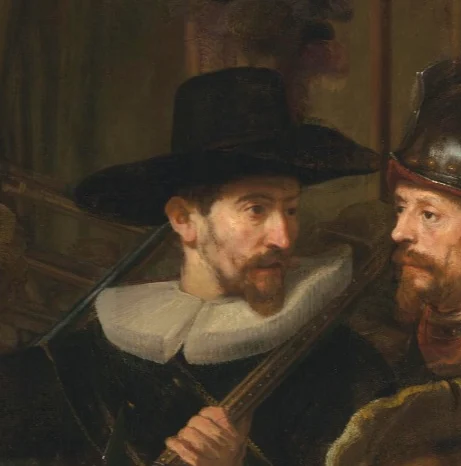
What you see
The crop shows the marked area in the original painting. Inspect its shapes, colours and position.
The project’s interpretation
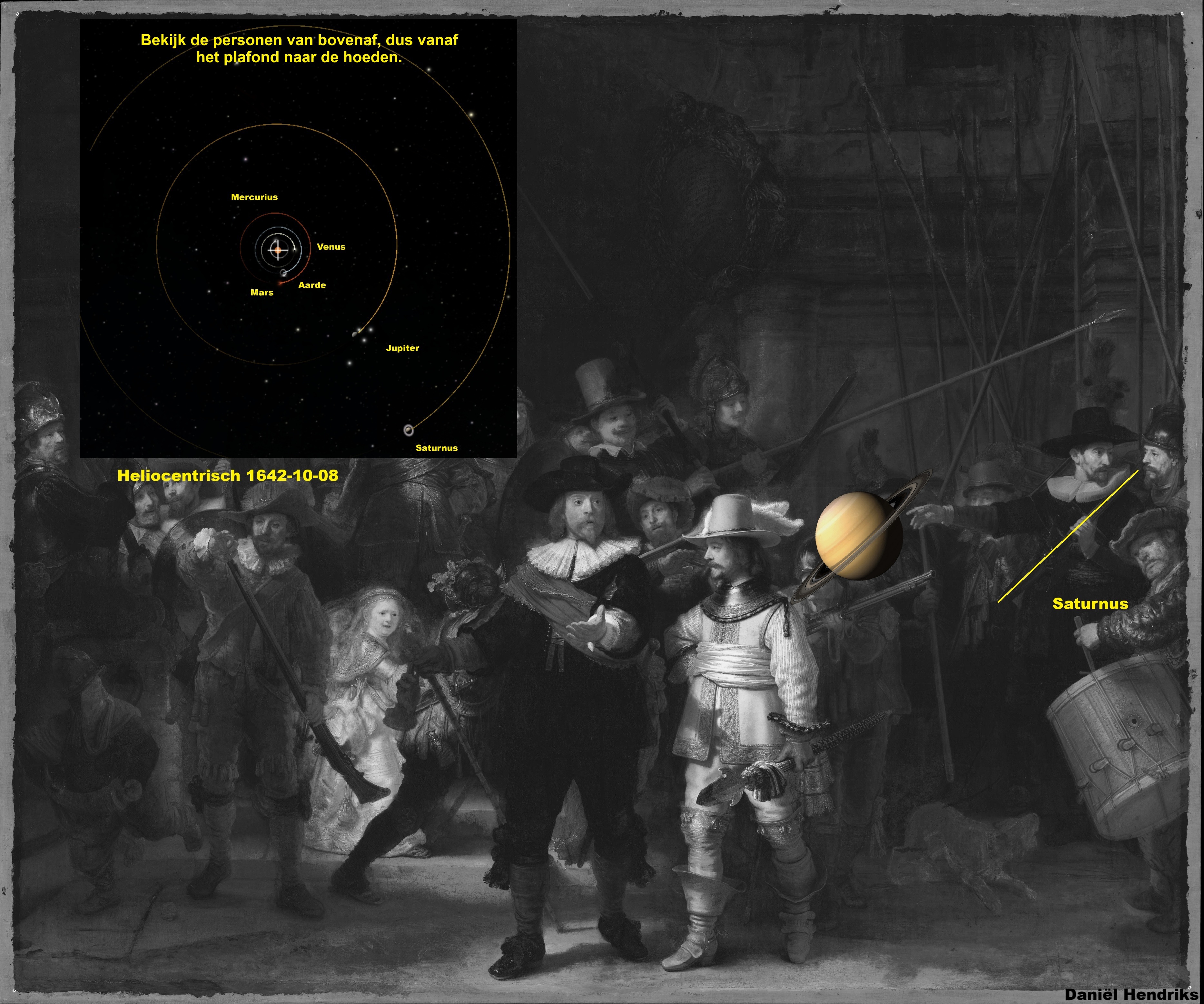
Saturn is the sixth planet and, for seventeenth-century astronomers, by far the most distant known planet of the solar system. With its tenuous ring system, it remained just within reach of the finest telescopes of Huygens’ generation in 1642; for Rembrandt and his contemporaries it was chiefly a bright “star” with a yellowish, puzzling…
Compare for yourself
Use Compare to inspect the original and the project’s interpretation at the same scale.
Open the interactive painting →Full project notes
Saturn is the sixth planet and, for seventeenth-century astronomers, by far the most distant known planet of the solar system. With its tenuous ring system, it remained just within reach of the finest telescopes of Huygens’ generation in 1642; for Rembrandt and his contemporaries it was chiefly a bright “star” with a yellowish, puzzling glow. That glow—or perhaps the sheen of its moons—is hinted at in The Night Watch by four hands that catch the light at precisely the same angle.
Heliocentric (Copernican viewpoint)
Seen from above the solar system, Saturn in October 1642 was a little over 9 AU (astronomical units) from the Sun, while Jupiter orbited on an inner track at about 5.2 AU. Their heliocentric longitudes differed by only a few degrees. During the total lunar eclipse, Earth slid between Sun and Moon (Sun - Earth - Moon in line); Saturn, owing to its slower orbit, lay slightly “behind” that line yet remained almost in the same ecliptic plane. In this scheme, then, Saturn appears close to Jupiter at the outer edge of the configuration, with the Sun at the centre. In The Night Watch this is translated visually: Saturn stands to the left of Jupiter and to the right of the Sun (the illuminated girl) and Mars (the man draped in red).
Geocentric (Amsterdam, 8 October 1642, ± 05:30 local time)
To the naked eye in Amsterdam the tableau looked reversed: the eclipsed full Moon hung low in the west, while Saturn and Jupiter appeared as a striking double “star” high in the south, in Libra. The Sun lay exactly beneath the eastern horizon, making the lunar eclipse possible. Because Earth briefly occupied the middle of the line, Saturn appeared visually next to the Moon (the girl) and to the left of Jupiter, even though heliocentrically it properly belongs on the Sun’s side.
Dual roles in The Night Watch
Rembrandt captures this apparent tension creatively in his hidden star chart: objects such as the fluttering flag and the musket smoke simultaneously represent the heliocentric and the geocentric positions. A single brushstroke can thus suggest both “Saturn next to Jupiter” (as seen from Earth) and “Saturn behind Jupiter” (as seen from the Sun). Both models therefore hold true, and the composition remains astronomically consistent.
Zoom in on subtle details such as the pale feather beside the drummer and the light-grey rim of the shield: exactly there the light of Saturn in 1642 crosses the boundary between sky and canvas.
Sources and astronomical comparison
The interpretation on this page belongs to this project. The references below come from the notes. A Stellarium comparison shows the specified sky configuration; it is not, by itself, a historical source for Rembrandt’s intention.
View the astronomical comparison in Stellarium ↗
No separate source references have been added for this subject yet.
About the research and its authorTechnical data and coordinates
Stellarium data
| Property | Value |
|---|---|
| object | Saturn |
| dateTime | 1642-10-08T04:30:00Z |
| lat | 52.377956 |
| lng | 4.89707 |
| fov | 40 |
Coordinates on the Night Watch (3734 × 3113)
| Number | Coordinates |
|---|---|
| 1 | 3232, 1274 |
| 2 | 3240, 1575 |
| 3 | 3533, 1580 |
| 4 | 3530, 1277 |