nebula
Pleiades (M45)
What you see
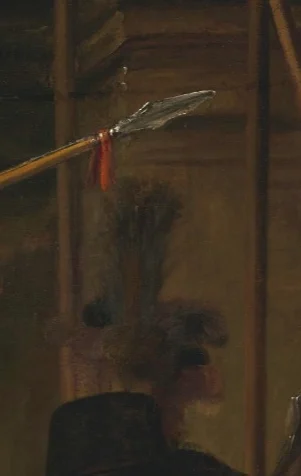
The crop shows the marked area in the original painting. Inspect its shapes, colours and position.
The project’s interpretation
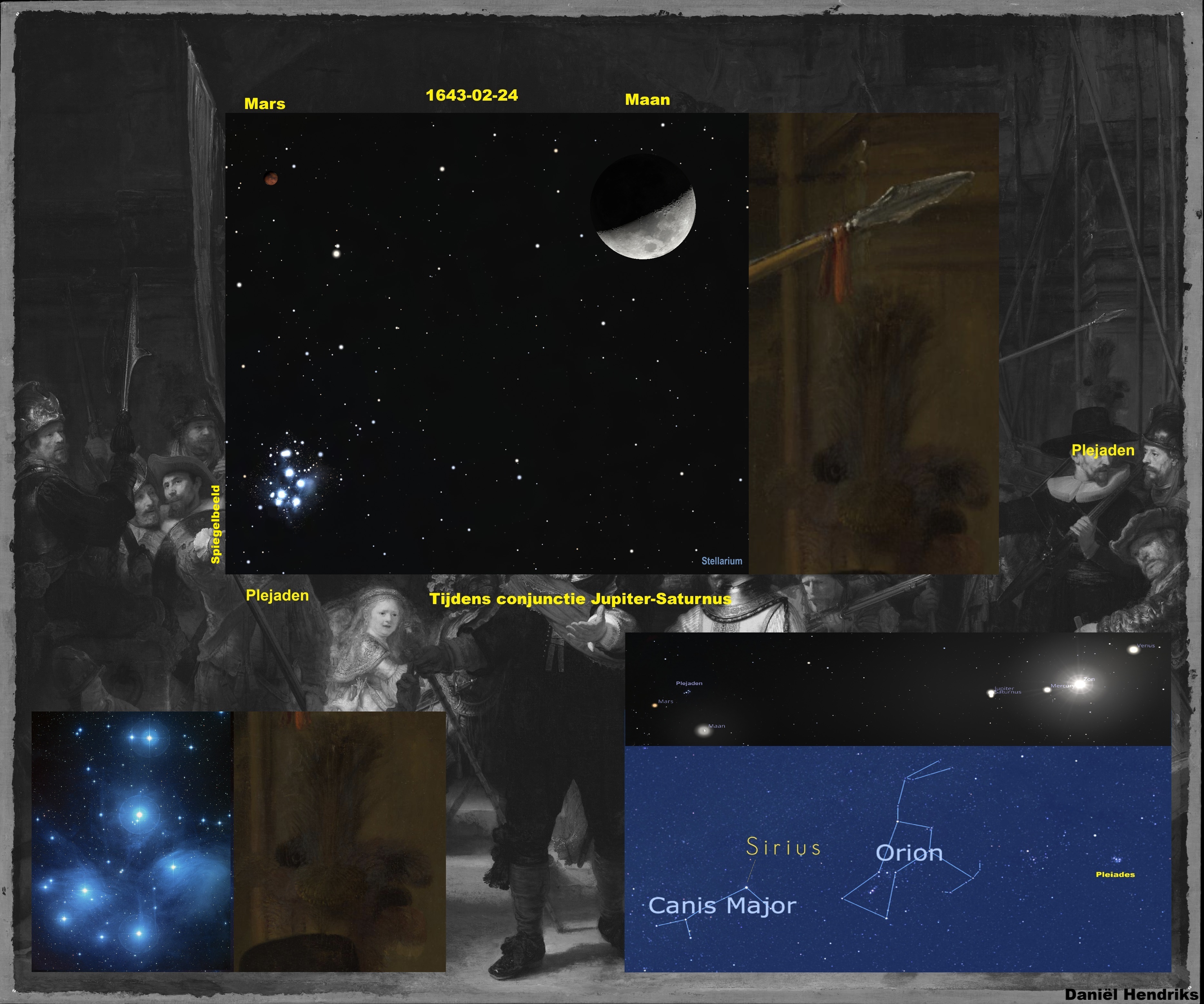
Pleiades (M 45) sparkle in The Night Watch as the airy feather adorning the hat of the musketeer just to the right of the Orion-spear tableau. The loose, fan-shaped brushstrokes echo, point for point, the fan-shaped pattern of the blue, hot stars in the open cluster. 24 Feb 1643 · Jupiter–Saturn conjunction During the great conjunction…
Compare for yourself
Use Compare to inspect the original and the project’s interpretation at the same scale.
Open the interactive painting →Full project notes
Pleiades (M 45) sparkle in The Night Watch as the airy feather adorning the hat of the musketeer just to the right of the Orion-spear tableau. The loose, fan-shaped brushstrokes echo, point for point, the fan-shaped pattern of the blue, hot stars in the open cluster.
24 Feb 1643 · Jupiter–Saturn conjunction
During the great conjunction of 24 February 1643, Mars, the Moon and the Pleiades formed a striking triangle west of Jupiter and Saturn. In the painting you can spot it like this: the arrow above the feather stands for the half-lit Moon, the red pennant on the shaft symbolizes Mars, and the feather itself represents the misty star swarm. Together they give the viewer an initial visual hint of the conjunction that unfolds across the entire right-hand panel.
Fixed sky & winter map
Because the Pleiades belong to the fixed stars, they need no double heliocentric–geocentric reading: wherever you stand, the cluster hangs high in the south-west on February evenings, just above Orion and Canis Major. Rembrandt (or Blaeu) exploits that fact by filling the whole right half of the canvas with a winter star chart in which the conjunction takes place.
Detail to watch
Zoom in on the subtle cobalt blue within the feather: that tiny patch of colour evokes the reflective glow of the nebula around Alcyone—a refined accent rarely seen elsewhere in the painting and one that immediately points to Blaeu’s astronomical signature.
Sources and astronomical comparison
The interpretation on this page belongs to this project. The references below come from the notes. A Stellarium comparison shows the specified sky configuration; it is not, by itself, a historical source for Rembrandt’s intention.
View the astronomical comparison in Stellarium ↗
No separate source references have been added for this subject yet.
About the research and its authorTechnical data and coordinates
Stellarium data
| Property | Value |
|---|---|
| object | pleiades |
| dateTime | 1643-02-24T18:00:00Z |
| lat | 52.377956 |
| lng | 4.89707 |
| fov | 40 |
Coordinates on the Night Watch (3734 × 3113)
| Number | Coordinates |
|---|---|
| 1 | 3360, 980 |
| 2 | 3357, 1248 |
| 3 | 3489, 1265 |
| 4 | 3498, 949 |