nebula
Orion Nebula (M42)

What you see
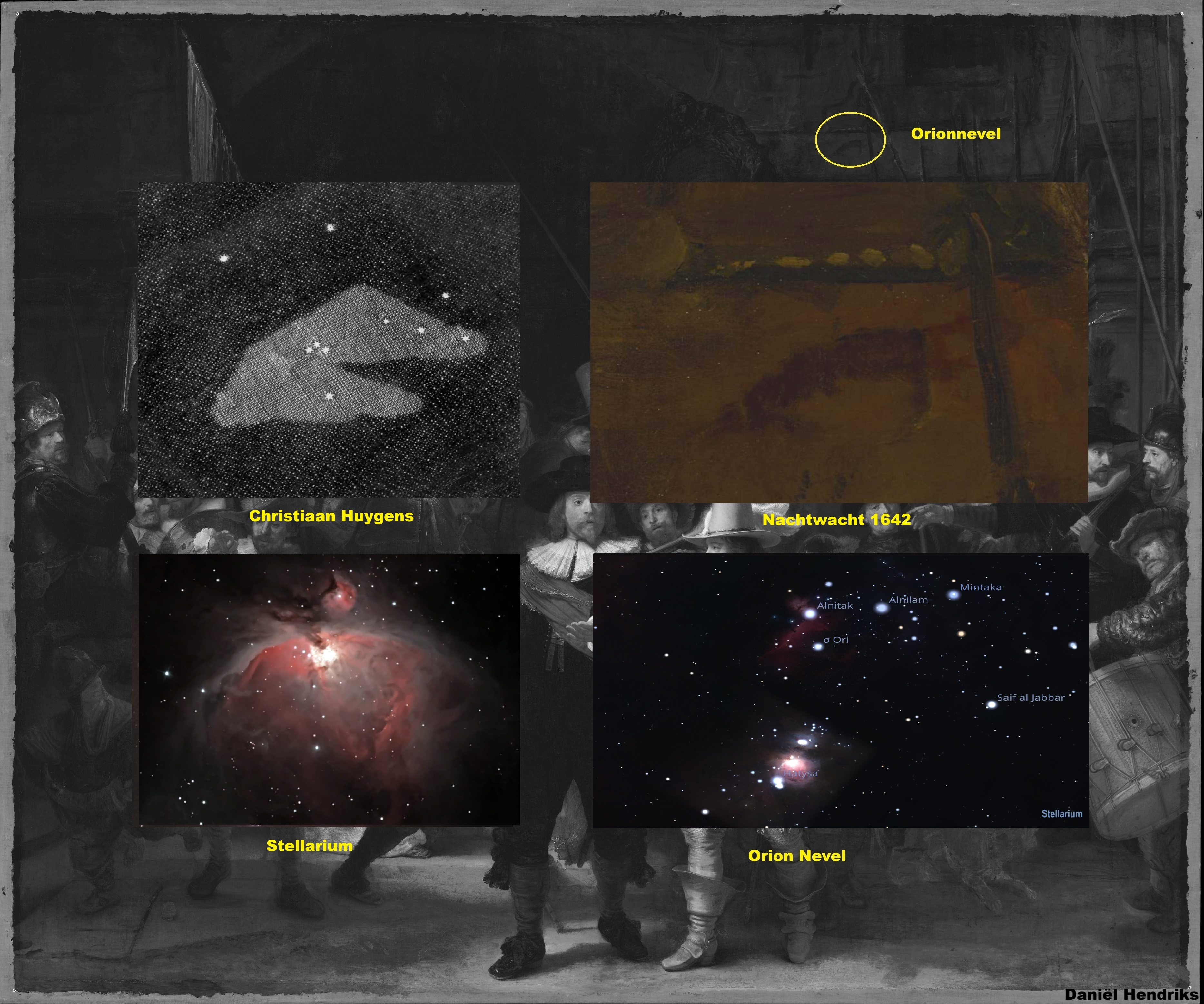
The crop shows the marked area in the original painting. Inspect its shapes, colours and position.
The project’s interpretation
Orion Nebula (M 42) – the mysterious, red-glowing cosmic cloud in Orion’s sword – had already entered the scholarly record before 1642: Peiresc sketched it on 26 November 1610, Cysat described it in 1619 and Galileo saw three bright stars within it in 1617. On the mornings of 8 October 1642 (lunar eclipse) and 24 February 1643 (Grand…
Compare for yourself
Use Compare to inspect the original and the project’s interpretation at the same scale.
Open the interactive painting →Full project notes
Orion Nebula (M 42) – the mysterious, red-glowing cosmic cloud in Orion’s sword – had already entered the scholarly record before 1642: Peiresc sketched it on 26 November 1610, Cysat described it in 1619 and Galileo saw three bright stars within it in 1617. On the mornings of 8 October 1642 (lunar eclipse) and 24 February 1643 (Grand Conjunction) the nebula hung low in the south-east or high in the south, just below the three belt-stars. Yet Joan Blaeu deliberately placed it in The Night Watch above the belt, visible as a crimson brush-stroke peppered with tiny dots.
Heliocentric projection trick
Blaeu treated the canvas as a flat star-map: he rotated Orion 180° around the ecliptic so that the night-sky “flips forward,” letting the nebula sit above the belt – exactly as on celestial globes where constellations are viewed from the outside. In this layout the nebula slips neatly into the rising ecliptic line traced by the crossed pikes, forming the junction between the winter sky and the 1642-43 planetary line-up.
Geocentric viewpoint
Seen frontally, the nebula becomes a cosmic puff of smoke just above the spear-points – a visual echo of the musket-flash elsewhere. For the observer on Earth this rotation turns Orion from an upright hunter into one who hangs upside-down, with the nebula dangling like a trophy above his belt. The painting thus shows how a single flip literally swaps celestial up and down.
Symbolism in the composition
By elevating M 42 Rembrandt links the red-painted nebula to the brightly lit girl (the Sun/Moon figure) and to the blood-red sash (the eclipse). The diffuse glow echoes the coppery tone of the eclipsed Moon, while the four dots inside the smear depict the Trapezium stars – a miniature heavenly company above the civic guard. The nebula therefore acts as a cosmic counterpart to earthly gunfire.
Detail to watch
Zoom in on the darkest edge of the red smear: there, where two minuscule white flecks form a tiny arc, you’ll find stand-ins for θ1 Ori C and θ2 Ori A – the heart of the Trapezium cluster. A single reversed brush-stroke thus reveals both the early-17th-century discovery and Blaeu’s cartographic signature.
Sources and astronomical comparison
The interpretation on this page belongs to this project. The references below come from the notes. A Stellarium comparison shows the specified sky configuration; it is not, by itself, a historical source for Rembrandt’s intention.
View the astronomical comparison in Stellarium ↗
No separate source references have been added for this subject yet.
About the research and its authorTechnical data and coordinates
Stellarium data
| Property | Value |
|---|---|
| object | m42 |
| dateTime | 1642-10-08T04:30:00Z |
| lat | 52.377956 |
| lng | 4.89707 |
| fov | 40 |
Coordinates on the Night Watch (3734 × 3113)
| Number | Coordinates |
|---|---|
| 1 | 2536, 374 |
| 2 | 2553, 502 |
| 3 | 2685, 502 |
| 4 | 2685, 374 |