constellation
Orion (Ori)

What you see
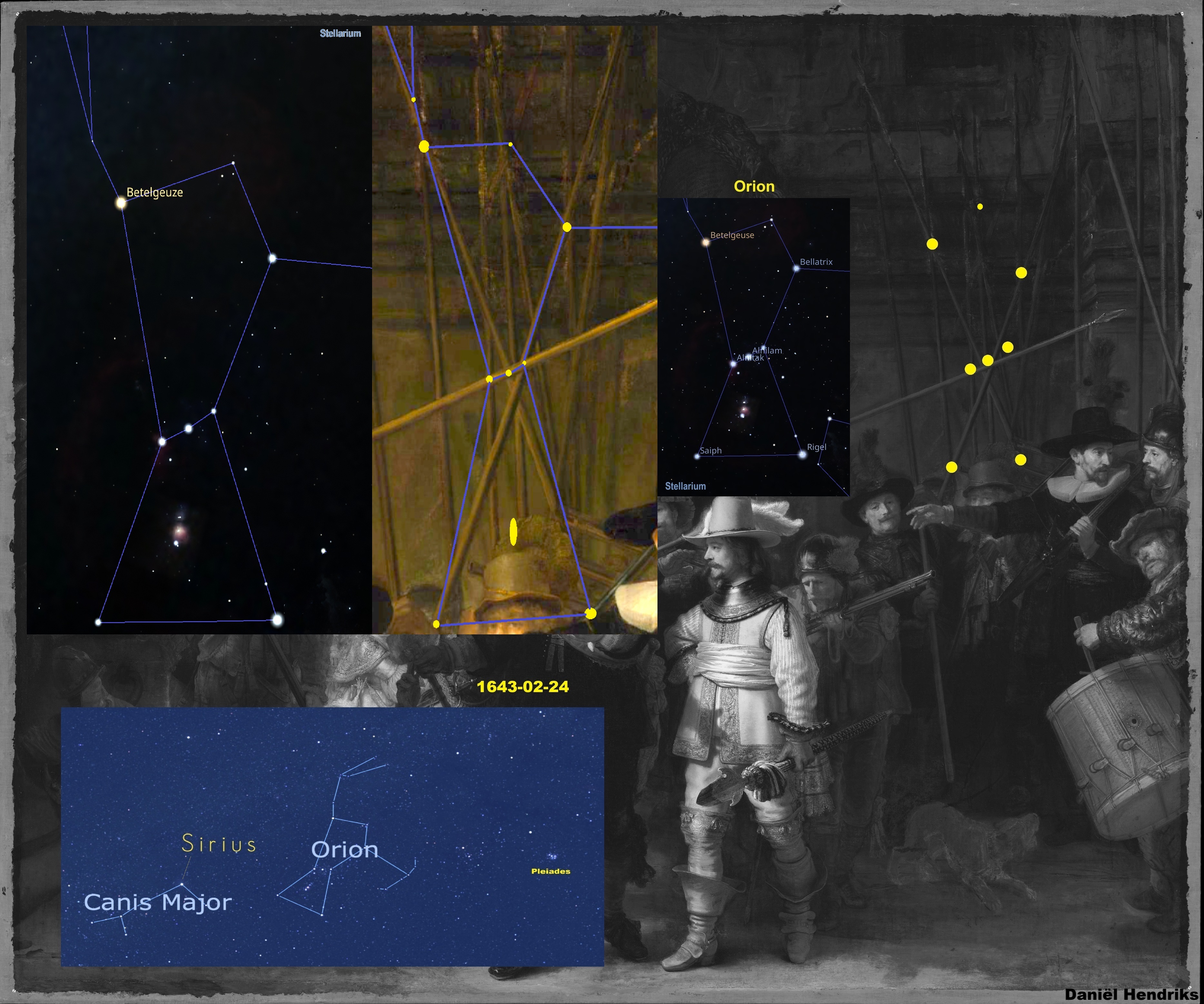
Long weapons cross in the upper right. Look at their tips and intersections.
The project’s interpretation
The project compares this arrangement of lines with the constellation Orion.
Compare for yourself
Switch between the original and the interpretation, then compare the marked points with Orion in Stellarium.
Open the interactive painting →Full project notes
Orion is the most recognizable winter constellation, with its three belt stars in a straight line and the glowing “sword nebula” beneath them. In the early morning of the lunar eclipse (8 October 1642, ± 05:30 local time) Orion had just risen in the east-southeast, still low above the horizon. Rembrandt (or Blaeu) rotated that scene for the composition and placed it high on the right of the canvas: the crossed spears mirror exactly the diamond formed by Betelgeuse, Bellatrix, Saiph, and Rigel, while the mid-way crossing of spear tips depicts the belt (Alnitak, Alnilam, Mintaka).
Position & possible shift
Because Orion was still low during the eclipse, its projection in the painting can seem slightly displaced. A second Stellarium snapshot for 24 February 1643 (21:00)—the evening when Jupiter and Saturn once again stood close together—shows precisely this pattern high in the sky. That later configuration explains why Orion appears so prominently in the upper right of The Night Watch, even though on the eclipse night itself it was more subdued.
Neighbouring constellations
At the foot of the spears a dog’s shadow “barks”—a nod to Canis Major with the brilliant Sirius. Slightly farther right, the plume on the black hat of the adjacent militiaman evokes the compact Pleiades (see the separate Pleiades page). Thus the entire upper-right quadrant of the canvas becomes a winter star chart, in which Jupiter and Saturn—painted a little lower—line up neatly with Orion as they did on 24 February 1643.
Compositional role
The spear tips point diagonally downward toward the eclipsed Moon and cross the invisible ecliptic, making Orion a bridge between the fixed winter sky and the wandering planets. The rhythm of the spears gives the viewer a kind of compass rose for deciphering the rest of the painting’s cosmic symbolism.
Detail to watch
Zoom in on the glint on the middle spear tip: a tiny, brighter dab of paint sits exactly where Alnilam, the heart of Orion’s belt, would be. That single dot anchors the entire constellation in both paint and time.
Sources and astronomical comparison
The interpretation on this page belongs to this project. The references below come from the notes. A Stellarium comparison shows the specified sky configuration; it is not, by itself, a historical source for Rembrandt’s intention.
View the astronomical comparison in Stellarium ↗
No separate source references have been added for this subject yet.
About the research and its authorTechnical data and coordinates
Stellarium data
| Property | Value |
|---|---|
| object | Orion |
| dateTime | 1642-10-08T04:30:00Z |
| lat | 52.377956 |
| lng | 4.89707 |
| fov | 40 |
Coordinates on the Night Watch (3734 × 3113)
Region 1
| Number | Coordinates |
|---|---|
| 1 | 2843, 660 |
| 2 | 3235, 660 |
| 3 | 2919, 1514 |
| 4 | 3191, 1502 |
Region 2
| Number | Coordinates |
|---|---|
| 1 | 2837, 1192 |
| 2 | 2837, 1236 |
| 3 | 3337, 1034 |
| 4 | 3316, 999 |