planet
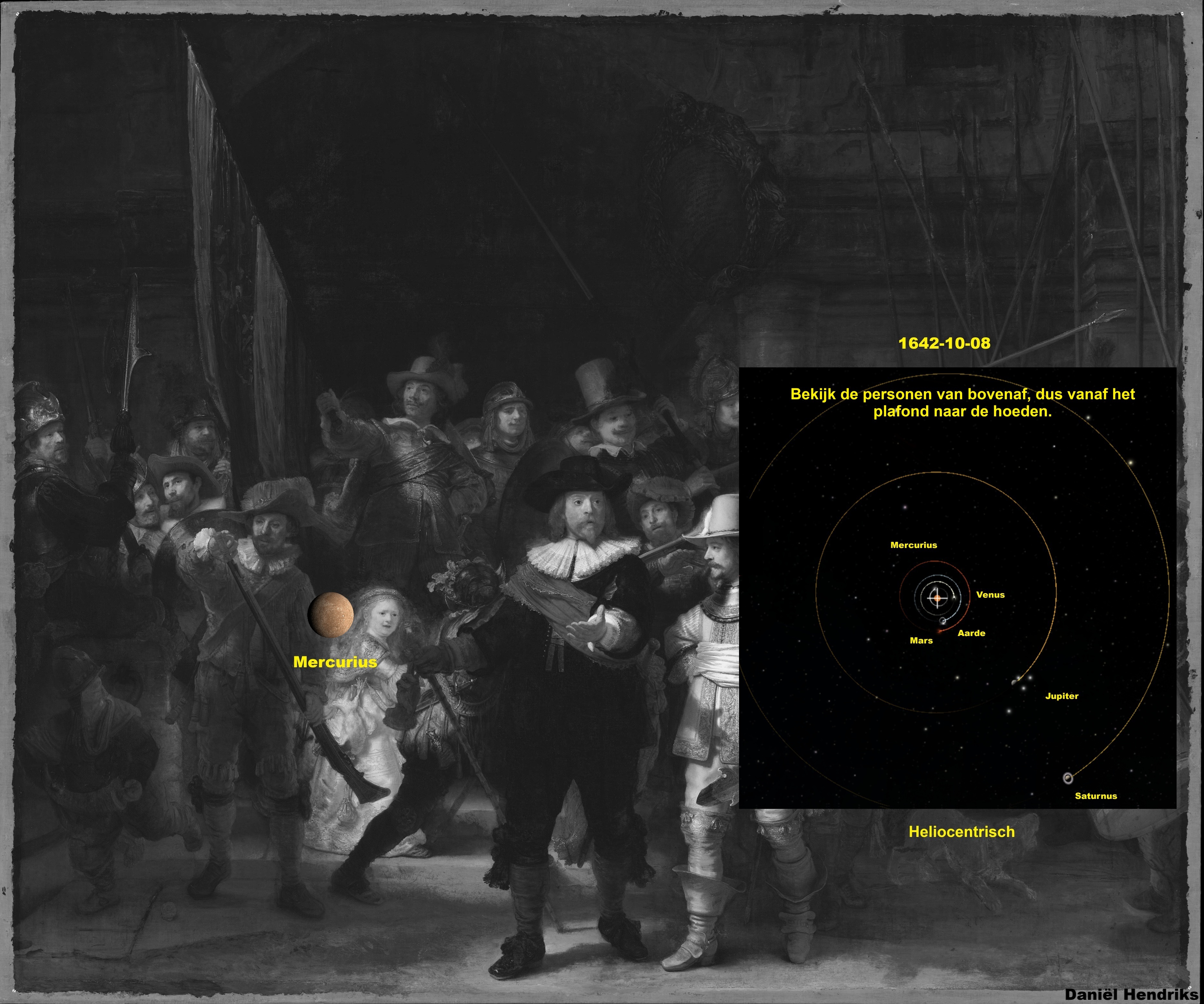
Mercury (1)
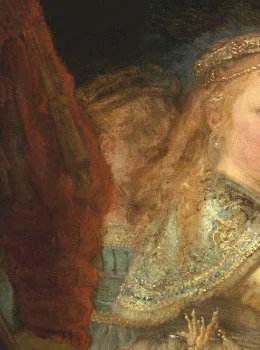
What you see
The crop shows the marked area in the original painting. Inspect its shapes, colours and position.
The project’s interpretation
Mercury (heliocentric) appears as the blue boy half–hidden behind the Radiant Girl. Lay The Night Watch flat and view it from above as if it were a Copernican map: the Girl sits exactly at the solar centre, the musketeer with oak-leaf helmet at one astronomical unit (Earth), and the boy—slightly closer to the Sun, just inside Earth’s…
Compare for yourself
Use Compare to inspect the original and the project’s interpretation at the same scale.
Open the interactive painting →Full project notes
Mercury (heliocentric) appears as the blue boy half–hidden behind the Radiant Girl. Lay The Night Watch flat and view it from above as if it were a Copernican map: the Girl sits exactly at the solar centre, the musketeer with oak-leaf helmet at one astronomical unit (Earth), and the boy—slightly closer to the Sun, just inside Earth’s orbit—symbolically occupies the correct Mercury position.
Colour as signature
The vivid blue of his jerkin stands out against an otherwise gold-brown palette. That flash of colour points to Dr Joan Blaeu, cartographer and probable designer of this hidden star chart. Blaeu often “signed” with cobalt and ultramarine hues, as in the Atlas Maior; here a single spot of blue is enough to guide the viewer toward his authorship.
Orbit & scale
Mercury has the tightest orbit (0.39 AU) and races round the Sun in 88 days. In the painting that narrow path is shown by the short distance between the boy and the Sun-Girl and by the slight angle his shoulder makes with the ecliptic-flag line—about 7°, Mercury’s maximum orbital tilt.
Detail to watch
Zoom in on the shining button on his left shoulder: a micro-dab of lead-white exactly 7° above the flag diagonal marks Mercury’s true ecliptic latitude on the Blood-Moon night. Even the fleetest planet is thus captured in a single brushstroke.
Sources and astronomical comparison
The interpretation on this page belongs to this project. The references below come from the notes. A Stellarium comparison shows the specified sky configuration; it is not, by itself, a historical source for Rembrandt’s intention.
View the astronomical comparison in Stellarium ↗
No separate source references have been added for this subject yet.
About the research and its authorTechnical data and coordinates
Stellarium data
| Property | Value |
|---|---|
| object | mercury |
| dateTime | 1642-10-08T04:30:00Z |
| lat | 52.377956 |
| lng | 4.89707 |
| fov | 40 |
Coordinates on the Night Watch (3734 × 3113)
| Number | Coordinates |
|---|---|
| 1 | 1000, 1876 |
| 2 | 1036, 2025 |
| 3 | 1051, 2060 |
| 4 | 1100, 1870 |