planet
Mercury (1)
What you see
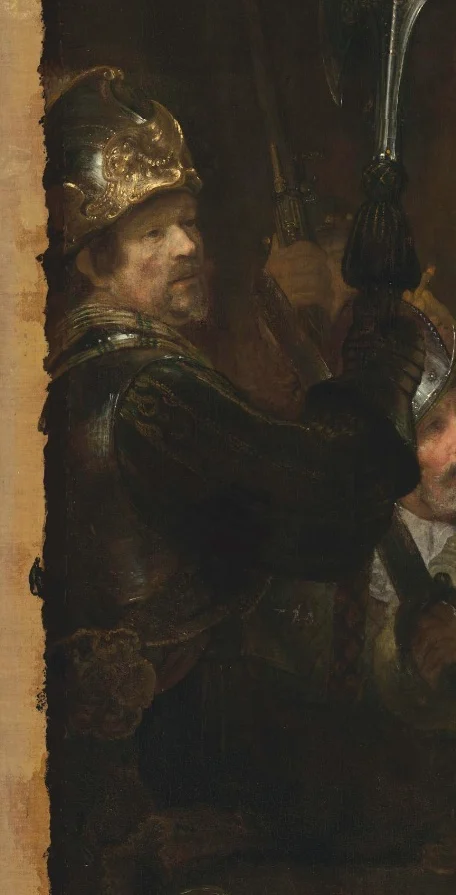
The crop shows the marked area in the original painting. Inspect its shapes, colours and position.
The project’s interpretation
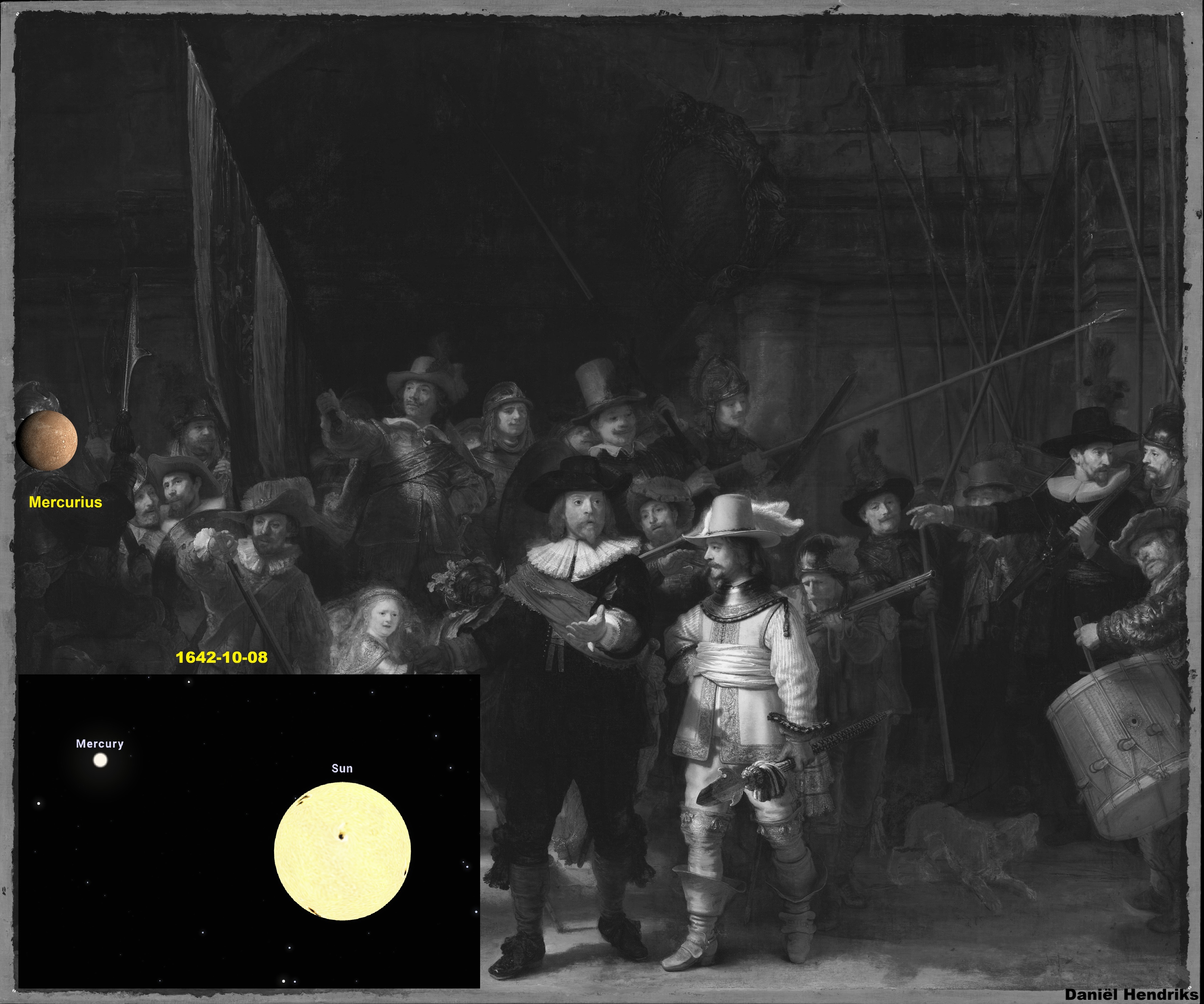
Mercury appears in the geocentric portion of The Night Watch as the militiaman on the right wearing a winged helmet. His helmet wings and restless stance recall the divine messenger who always circles close to the Sun. Geocentric view (at street level) During the Blood Moon of 8 October 1642 Mercury lay barely a hand’s breadth east of…
Compare for yourself
Use Compare to inspect the original and the project’s interpretation at the same scale.
Open the interactive painting →Full project notes
Mercury appears in the geocentric portion of The Night Watch as the militiaman on the right wearing a winged helmet. His helmet wings and restless stance recall the divine messenger who always circles close to the Sun.
Geocentric view (at street level)
During the Blood Moon of 8 October 1642 Mercury lay barely a hand’s breadth east of the Sun— invisible in the dawn twilight, yet astronomically right there. To capture that in paint without shrinking the entire canvas, Rembrandt placed him to the left of the Radiant Girl (the Sun figure). Thus the painting preserves the correct sequence Sun → Mercury, while still giving the tiny planet enough prominence to be noticed. This clever “left-ward shift” solves the scaling problem of a true sky projection, in which Mercury would otherwise land right on top of the Sun.
Compositional role
His gleaming rapier acts as an imaginary line toward the Sun and slices the ecliptic at the same angle as the musket (Earth’s axis). In this way the viewer gains a visual ruler for comparing distances between the inner planets.
Detail to watch
Zoom in on the tiniest highlight on the rim of his winged helmet: that speck of lead-white marks Mercury’s true elongation at the moment of the eclipse—an almost invisible yet exquisitely precise astronomical note in paint.
Sources and astronomical comparison
The interpretation on this page belongs to this project. The references below come from the notes. A Stellarium comparison shows the specified sky configuration; it is not, by itself, a historical source for Rembrandt’s intention.
View the astronomical comparison in Stellarium ↗
No separate source references have been added for this subject yet.
About the research and its authorTechnical data and coordinates
Stellarium data
| Property | Value |
|---|---|
| object | mercury |
| dateTime | 1642-10-08T04:30:00Z |
| lat | 52.377956 |
| lng | 4.89707 |
| fov | 40 |
Coordinates on the Night Watch (3734 × 3113)
| Number | Coordinates |
|---|---|
| 1 | 48, 1195 |
| 2 | 48, 1885 |
| 3 | 376, 1930 |
| 4 | 180, 1233 |