planet
Mars (4)
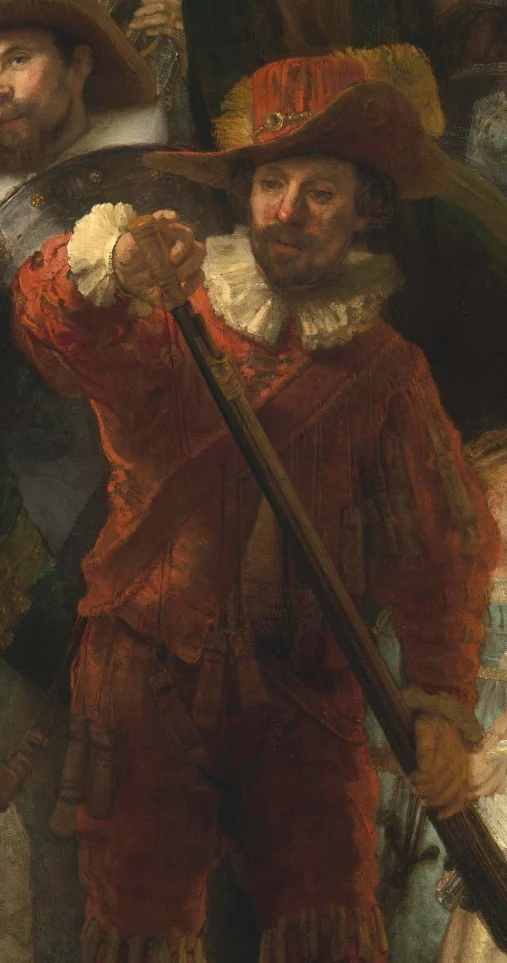
What you see
The crop shows the marked area in the original painting. Inspect its shapes, colours and position.
The project’s interpretation
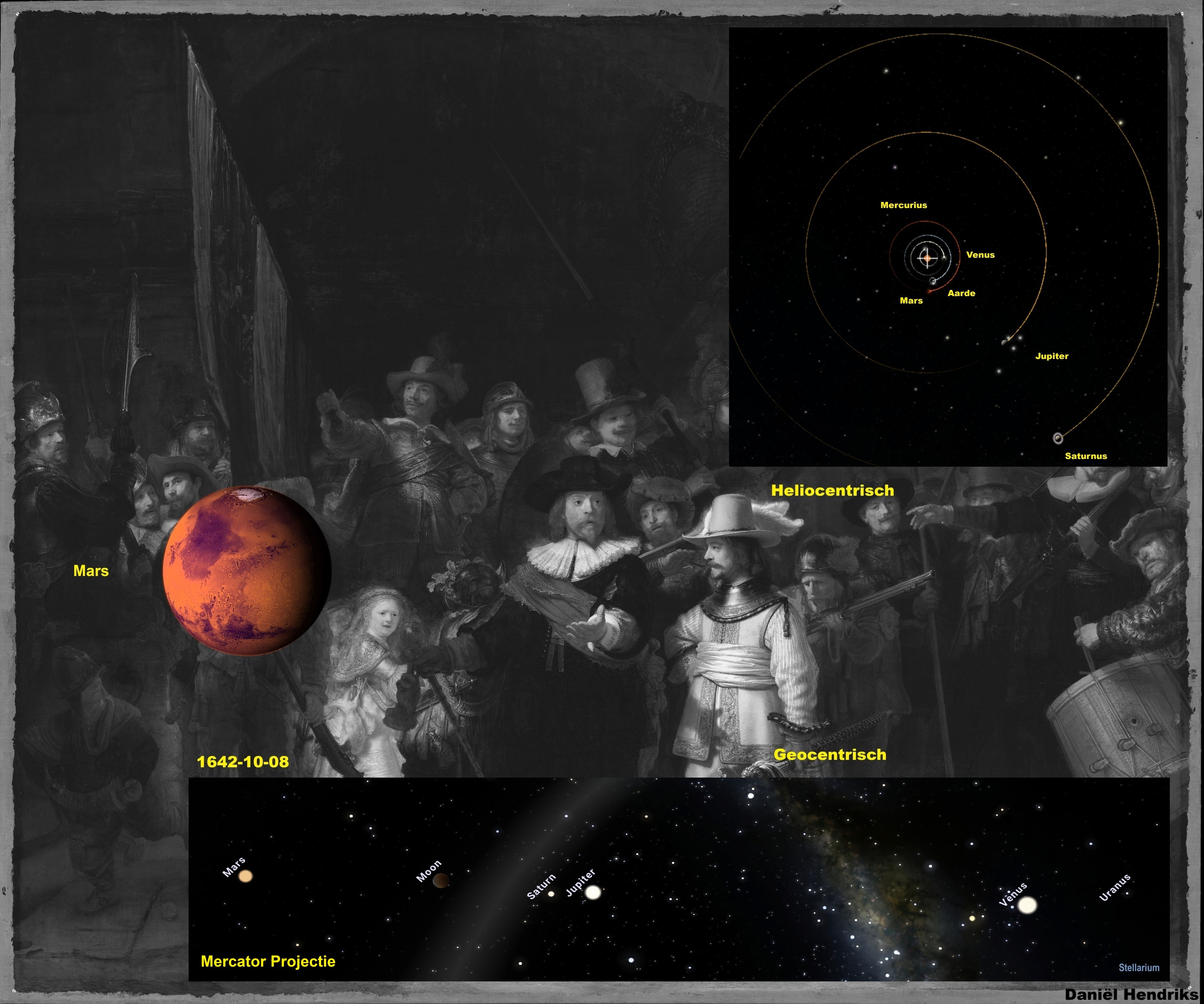
Mars is personified in The Night Watch by the striking red militiaman in the left foreground. His crimson doublet and mail shirt gleam like the planet’s oxidised surface, so no one can doubt his cosmic identity. Heliocentric view (seen from above) Flatten the painting into a Copernican diagram and look down on it. Starting from the…
Compare for yourself
Use Compare to inspect the original and the project’s interpretation at the same scale.
Open the interactive painting →Full project notes
Mars is personified in The Night Watch by the striking red militiaman in the left foreground. His crimson doublet and mail shirt gleam like the planet’s oxidised surface, so no one can doubt his cosmic identity.
Heliocentric view (seen from above)
Flatten the painting into a Copernican diagram and look down on it. Starting from the Radiant Girl (the Sun), draw concentric circles: at 1 AU stands the man with the oak-leaf helmet (Earth); at 1.5 AU comes Mars—and precisely there, slightly left of the celestial mid-line, stands our red soldier. His position between the Sun and the distant gas giants shows that Mars is an “inner outer planet”—inside the line of Jupiter and Saturn yet outside Earth’s orbit. Because, in this overhead view, the Moon hides behind Earth, the Blood Moon is not a figure but appears as the deep-red sash streaming behind Captain Frans Banning Cocq. At a glance you see the sequence Sun (girl) – Earth (oak-helm man) – Moon (red band) – Mars (red-clad militiaman).
Geocentric view (at eye level on Dam Square)
Stand upright again and view the canvas head-on: now you see the planetary row as it appeared in the sky around 05:30 on 8 October 1642. Mars shone low in the south-east in Capricorn, clearly to the left (east) of the blood-red Moon setting westward. That projection is rendered in paint: the red soldier stands left front, while the eclipsed-Moon figure (the Girl) glows slightly right of centre. The rest of the company marks Jupiter, Saturn, and the other planets at their visible positions.
Military-cosmic symbolism
As god of war, Mars’ fiery stance suits the musket shot in the centre: he is poised to follow the powder flash (the Sun) in an imagined trajectory toward Jupiter, turning the military action into a literal planetary salvo.
Detail to watch
Zoom in on the glittering buckle on his belt: that single bright dab of lead white sits exactly on the ecliptic’s 23½° tilt and marks Mars’ true ecliptic longitude at the moment of the Blood Moon—a subtle yet unerring marching order in paint.
Sources and astronomical comparison
The interpretation on this page belongs to this project. The references below come from the notes. A Stellarium comparison shows the specified sky configuration; it is not, by itself, a historical source for Rembrandt’s intention.
View the astronomical comparison in Stellarium ↗
No separate source references have been added for this subject yet.
About the research and its authorTechnical data and coordinates
Stellarium data
| Property | Value |
|---|---|
| object | mars |
| dateTime | 1642-10-08T04:30:00Z |
| lat | 52.377956 |
| lng | 4.89707 |
| fov | 40 |
Coordinates on the Night Watch (3734 × 3113)
| Number | Coordinates |
|---|---|
| 1 | 788, 1514 |
| 2 | 627, 1838 |
| 3 | 613, 2317 |
| 4 | 902, 2317 |
| 5 | 960, 1800 |
| 6 | 925, 1525 |