line
Lunar Nodes
What you see
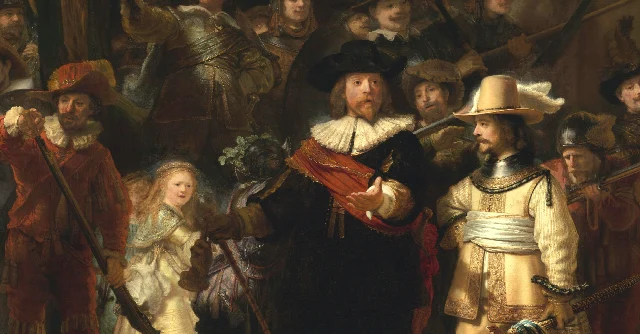
The crop shows the marked area in the original painting. Inspect its shapes, colours and position.
The project’s interpretation
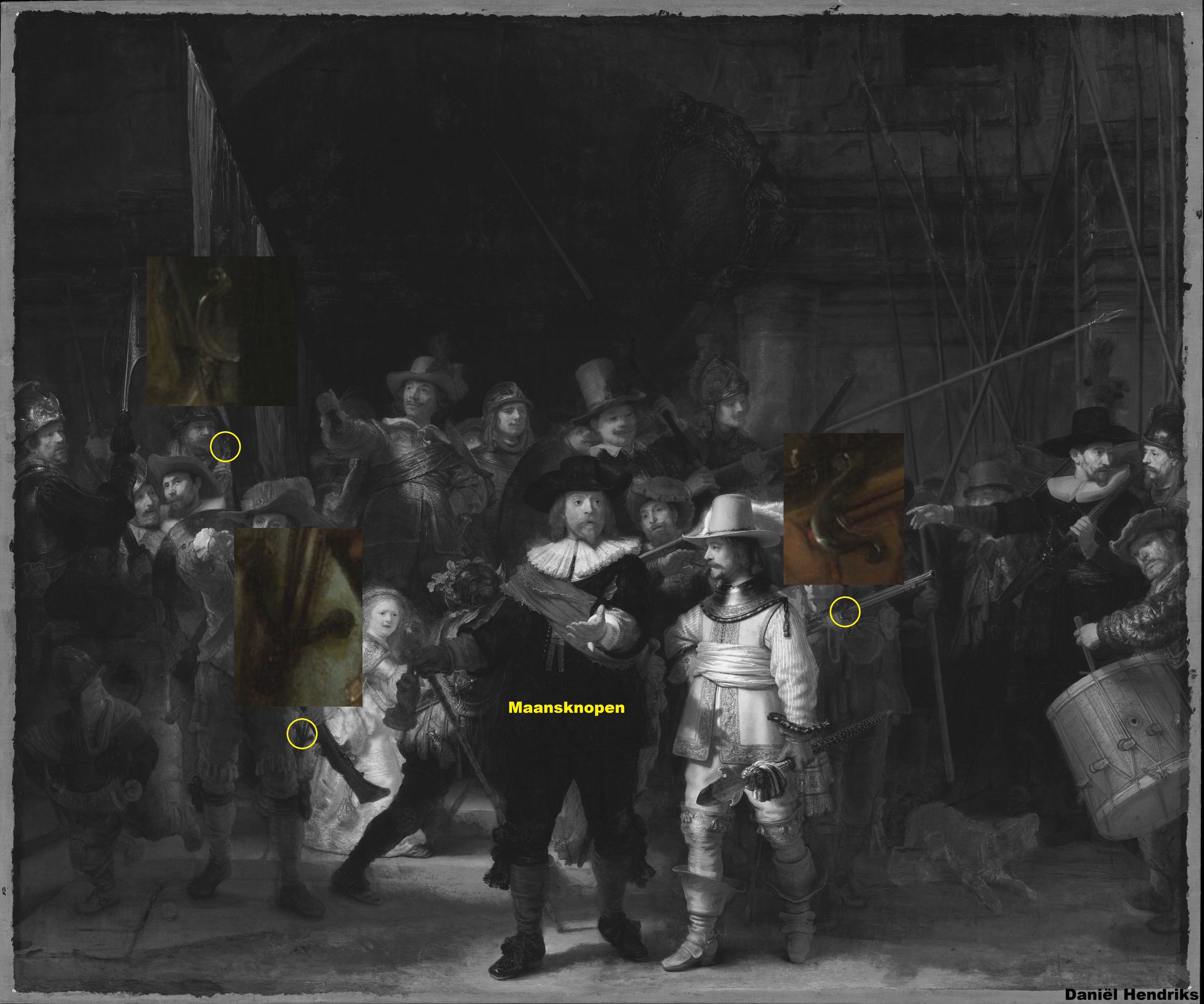
Lunar Nodes (☊ and ☋) form the invisible hinge on which Rembrandt’s cosmic map turns. The two U-shaped musket rests in the upper left and right corners of the painting are not merely military props: they represent the northern (ascending) and southern (descending) points where the Moon’s orbit crosses the ecliptic. It was precisely at…
Compare for yourself
Use Compare to inspect the original and the project’s interpretation at the same scale.
Open the interactive painting →Full project notes
Lunar Nodes (☊ and ☋) form the invisible hinge on which Rembrandt’s cosmic map turns. The two U-shaped musket rests in the upper left and right corners of the painting are not merely military props: they represent the northern (ascending) and southern (descending) points where the Moon’s orbit crosses the ecliptic. It was precisely at these nodes that the total blood-moon of 8 October 1642 could occur – the celestial drama that recent research claims the Night Watch hides in paint.
Heliocentric (top-down view)
Lay the painting flat like a Copernican planisphere: the rising diagonal flag marks the ecliptic, while a row of muskets suggests the slightly tilted lunar path. Wherever those two great circles intersect, Rembrandt placed the horseshoe-shaped rests. The left rest (☊) marks the point where the Moon ascends from the southern to the northern celestial hemisphere; the right rest (☋) marks the mirror point 180° away. Together they anchor the symmetrical lunar path in the plane of the painted sky and explain why Sun, Earth and Moon lined up that night.
Geocentric (street-level view)
Seen head-on, the lunar nodes align exactly with the eastern and western horizons. On the left (by the rising Sun) the north node points toward the future – the light the company is marching into. On the right (by the setting, eclipsed Moon) the south node hangs in shadow – the karmic past being left behind. Thus the nodes convey not only the astronomical location of the eclipse but also the dramatic arc from darkness to dawn within the composition.
Symbolism of destiny & past
In astrology, the north node stands for growth and destiny, the south node for old patterns. Rembrandt echoes this by literally moving the troop from right (☋) to left (☊): the guardsmen abandon the past and march toward the dawn. The nodes thus form the spiritual backbone of the scene, an invitation to release the old and embrace the new.
Double crossing function
The horseshoes mark not only the lunar nodes but also the intersection of compositional lines: they sit on the imagined horizon axis and cross the ecliptic diagonal. This double cross-function makes them anchor bolts in Rembrandt’s hidden celestial grid; without these points the whole astronomical net would shift.
Detail to watch
Zoom in on the tiny stroke of lead white atop each rest: that pin-prick of light marks the exact geometric node where the lunar and solar paths meet. Whoever spots that dot quite literally holds the key to the eclipse.
Sources and astronomical comparison
The interpretation on this page belongs to this project. The references below come from the notes. A Stellarium comparison shows the specified sky configuration; it is not, by itself, a historical source for Rembrandt’s intention.
No separate source references have been added for this subject yet.
About the research and its authorTechnical data and coordinates
Coordinates on the Night Watch (3734 × 3113)
Region 1
| Number | Coordinates |
|---|---|
| 1 | 683, 1373 |
| 2 | 668, 1441 |
| 3 | 724, 1446 |
| 4 | 735, 1359 |
Region 2
| Number | Coordinates |
|---|---|
| 1 | 2597, 1861 |
| 2 | 2588, 1937 |
| 3 | 2670, 1929 |
| 4 | 2641, 1861 |
Region 3
| Number | Coordinates |
|---|---|
| 1 | 908, 2206 |
| 2 | 914, 2306 |
| 3 | 960, 2329 |
| 4 | 972, 2271 |