constellation
Lizard (Lac)
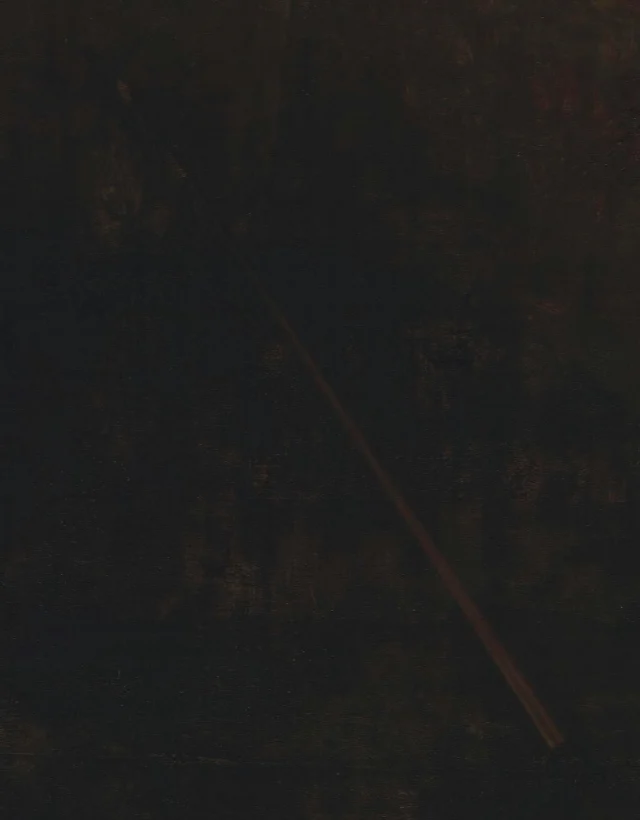
What you see
The crop shows the marked area in the original painting. Inspect its shapes, colours and position.
The project’s interpretation
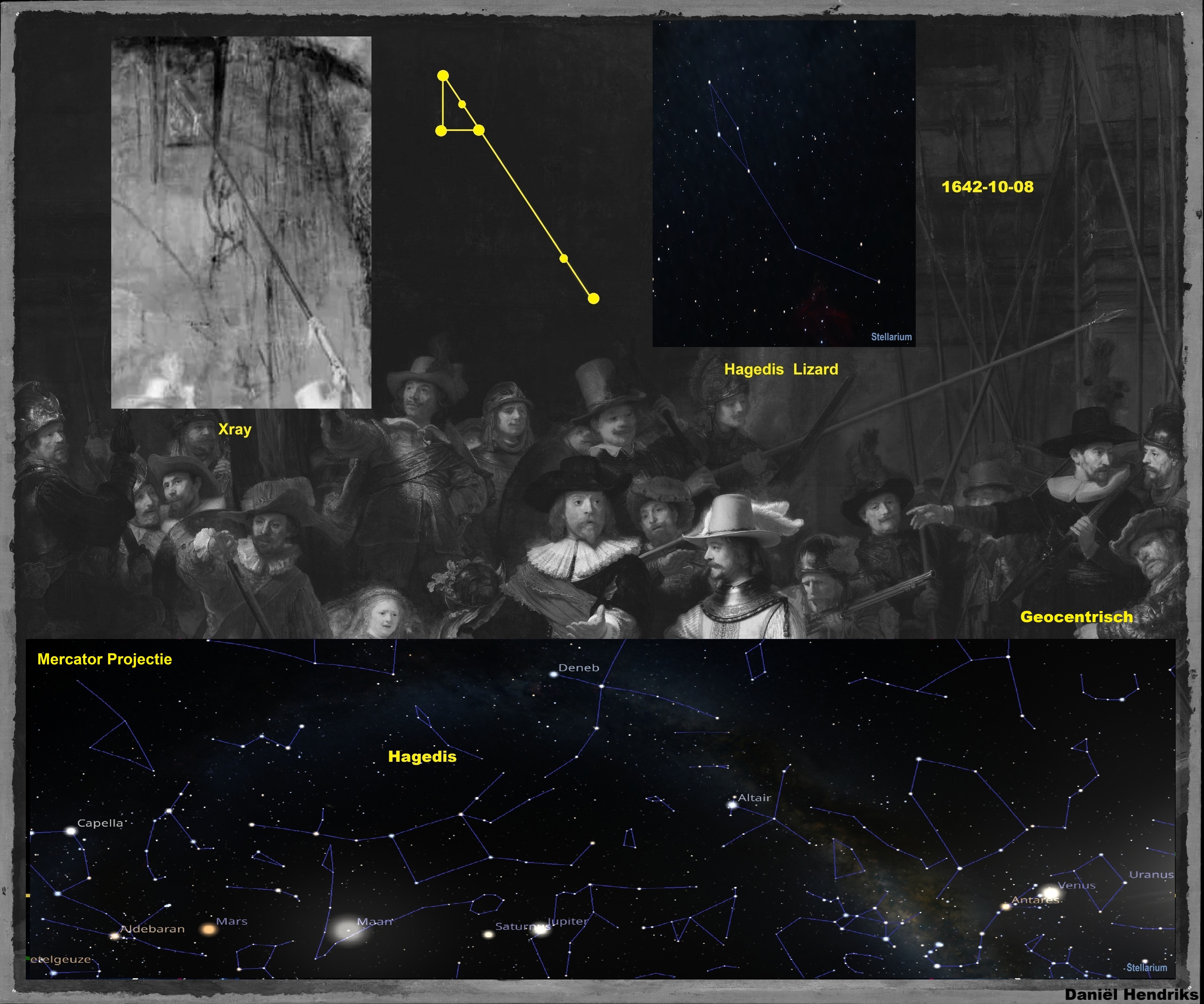
Lizard—an ancient Greek name for “the Little Goat”—appears in The Night Watch as the small company flag to the right of the large Perseus banner. X-ray images reveal that the lower section of the flagstaff was deliberately darkened, creating on the canvas the same slight kink that the stars η and ζ Aurigae (the historical Hagadis twins)…
Compare for yourself
Use Compare to inspect the original and the project’s interpretation at the same scale.
Open the interactive painting →Full project notes
Lizard—an ancient Greek name for “the Little Goat”—appears in The Night Watch as the small company flag to the right of the large Perseus banner. X-ray images reveal that the lower section of the flagstaff was deliberately darkened, creating on the canvas the same slight kink that the stars η and ζ Aurigae (the historical Hagadis twins) form in the sky.
Orientation & positioning
In the overhead view the entire staff follows the 23½° tilt of Earth’s axis, so Hagadis—like the large flag—fits neatly into the ecliptic grid. Draw an imaginary line from the tip of the small flag up to the left and you reach Polaris on the tip of the big flagstaff, anchoring the north-eastern sky in the same compass system as Perseus and Ursa Major.
Compositional role
Because Hagadis is a modest star group, the small flag acts as a visual way-station between the broad Perseus banner and the slender lines of the rear spears (Orion). The darkened lower segment of the staff also creates an optical “break,” so the viewer immediately recognises the two Hero stars in Auriga as a distinct pair.
Detail to watch
Zoom in on the tiny lead-white dot at the junction where the dark and light wood grain meet: that pinpoint marks η Aurigae’s ecliptic longitude on 8 October 1642—calculated with precision and fixed in place by a single brush-prick.
Sources and astronomical comparison
The interpretation on this page belongs to this project. The references below come from the notes. A Stellarium comparison shows the specified sky configuration; it is not, by itself, a historical source for Rembrandt’s intention.
View the astronomical comparison in Stellarium ↗
No separate source references have been added for this subject yet.
About the research and its authorTechnical data and coordinates
Stellarium data
| Property | Value |
|---|---|
| object | lacerta |
| dateTime | 1642-10-08T04:30:00Z |
| lat | 52.377956 |
| lng | 4.89707 |
| fov | 40 |
Coordinates on the Night Watch (3734 × 3113)
| Number | Coordinates |
|---|---|
| 1 | 1378, 227 |
| 2 | 1330, 415 |
| 3 | 1478, 423 |
| 4 | 1808, 926 |
| 5 | 1840, 909 |
| 6 | 1405, 233 |