planet
Jupiter (5)
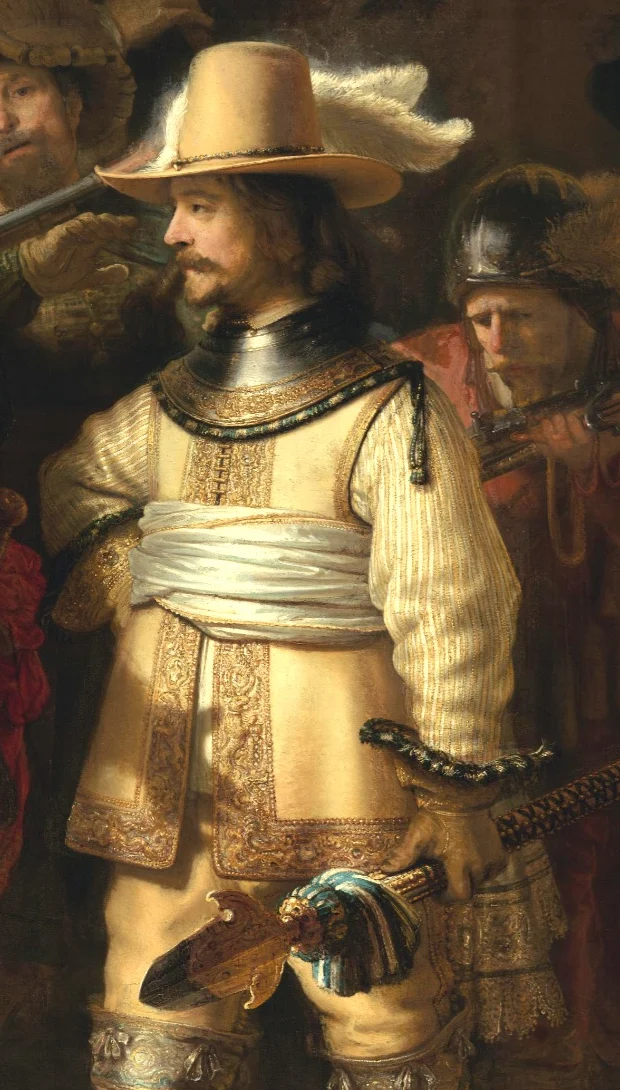
What you see
The crop shows the marked area in the original painting. Inspect its shapes, colours and position.
The project’s interpretation
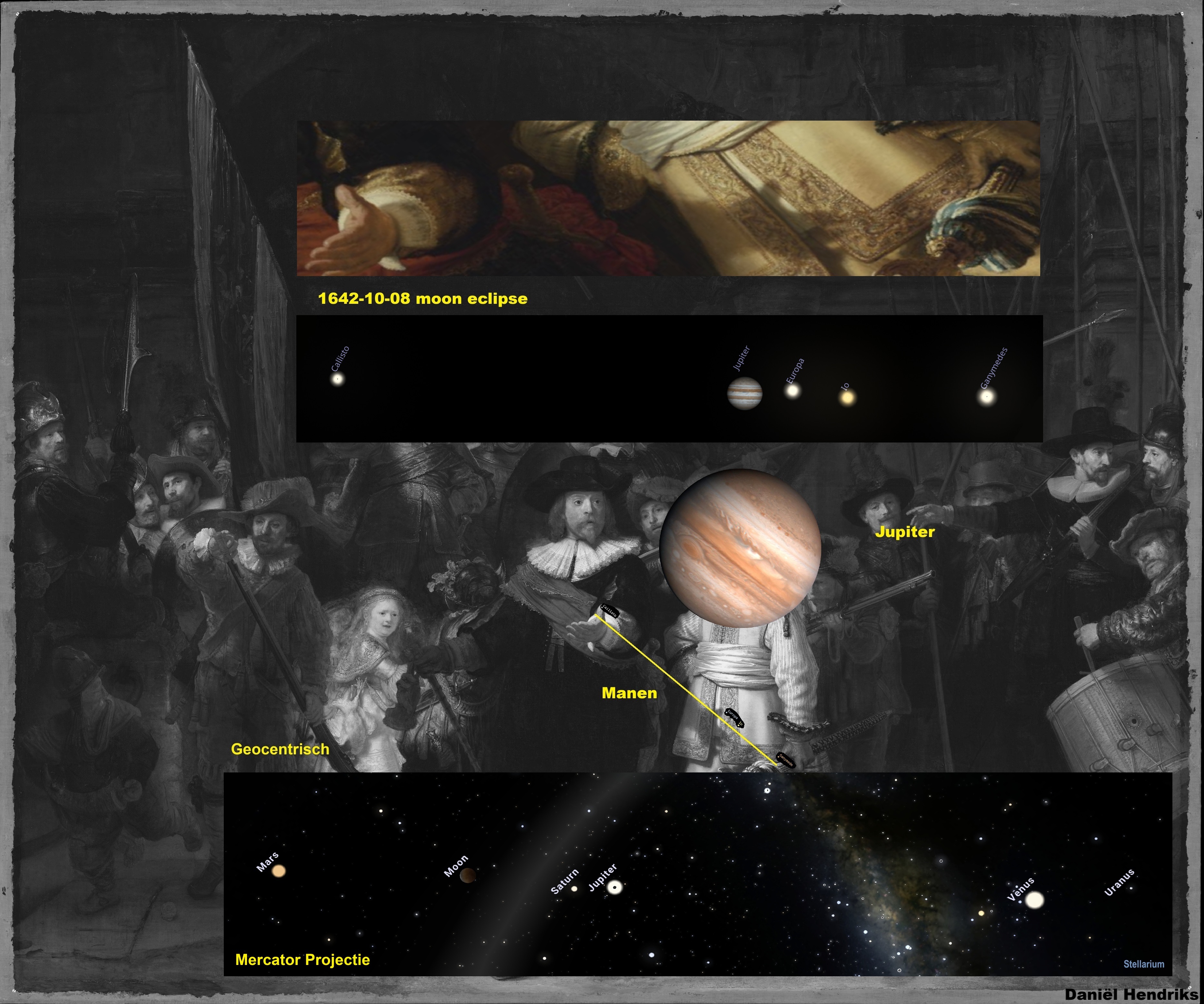
Jupiter appears in The Night Watch as the proud lieutenant in gleaming white with the golden sash. His brightness, dignified stance and central position make him instantly recognisable as the solar system’s largest planet. Heliocentric view (seen from above) Lay the canvas flat like a Copernican diagram: from the Radiant Girl (the Sun)…
Compare for yourself
Use Compare to inspect the original and the project’s interpretation at the same scale.
Open the interactive painting →Full project notes
Jupiter appears in The Night Watch as the proud lieutenant in gleaming white with the golden sash. His brightness, dignified stance and central position make him instantly recognisable as the solar system’s largest planet.
Heliocentric view (seen from above)
Lay the canvas flat like a Copernican diagram: from the Radiant Girl (the Sun) draw orbits at 1 AU (Earth) and then at 5.2 AU—exactly there stands Jupiter, half-left of the solar axis. His white doublet and command sash shine like the planet’s cloud bands. Because Jupiter was almost in conjunction with Saturn around the eclipse, you find the red Mars militiaman further in and Saturn farther out: a perfect mirror of the real planetary order.
Geocentric view (at street level)
Seen head-on, Jupiter stood high in the south in the early hours of 8 October 1642, just to the right of the nadir line through the eclipsed Moon. That spot is embodied by the white lieutenant slightly right of the Girl-Moon figure. His raised arm—directing the troops—marks the ecliptic and points toward Saturn, while his own torso represents the planet itself.
The Galilean moons
Rembrandt even included Jupiter’s four largest moons; you just need to know where to look:
• Io – the tip of the index finger of the shadow hand.
• Europa – the tip of the thumb of the shadow hand.
• Ganymede – the tip of the lieutenant’s left thumb (the man in white).
• Callisto – the tip of the captain’s left thumb (the man in black).
Together they form a miniature homage to Galileo’s discovery, elegantly hidden in the gestures of the hands.
Military–cosmic symbolism
With a broad sweep of his arm the lieutenant issues orders; at the same time he “drags” his moons with him, just as Jupiter keeps its satellites in orbit. His command sash—foreshortened into an arc—follows exactly the 23½° tilt of the ecliptic, so the viewer intuitively recognises the planetary path.
Detail to watch
Zoom in on the brightest pearly gleam in the sash just below his shoulder: that tiny dab of lead-white marks Jupiter’s true ecliptic longitude at the moment of the Blood Moon—a precise planetary coordinate captured in a single brushstroke.
Sources and astronomical comparison
The interpretation on this page belongs to this project. The references below come from the notes. A Stellarium comparison shows the specified sky configuration; it is not, by itself, a historical source for Rembrandt’s intention.
View the astronomical comparison in Stellarium ↗
No separate source references have been added for this subject yet.
About the research and its authorTechnical data and coordinates
Stellarium data
| Property | Value |
|---|---|
| object | jupiter |
| dateTime | 1642-10-08T04:30:00Z |
| lat | 52.377956 |
| lng | 4.89707 |
| fov | 40 |
Coordinates on the Night Watch (3734 × 3113)
| Number | Coordinates |
|---|---|
| 1 | 2200, 1580 |
| 2 | 2100, 2330 |
| 3 | 2560, 2500 |
| 4 | 2314, 1570 |