designer
dr. J. Blaeu (O2)
What you see
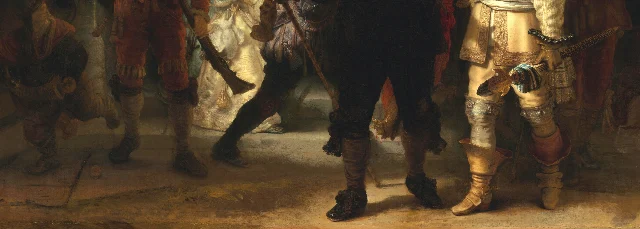
The crop shows the marked area in the original painting. Inspect its shapes, colours and position.
The project’s interpretation
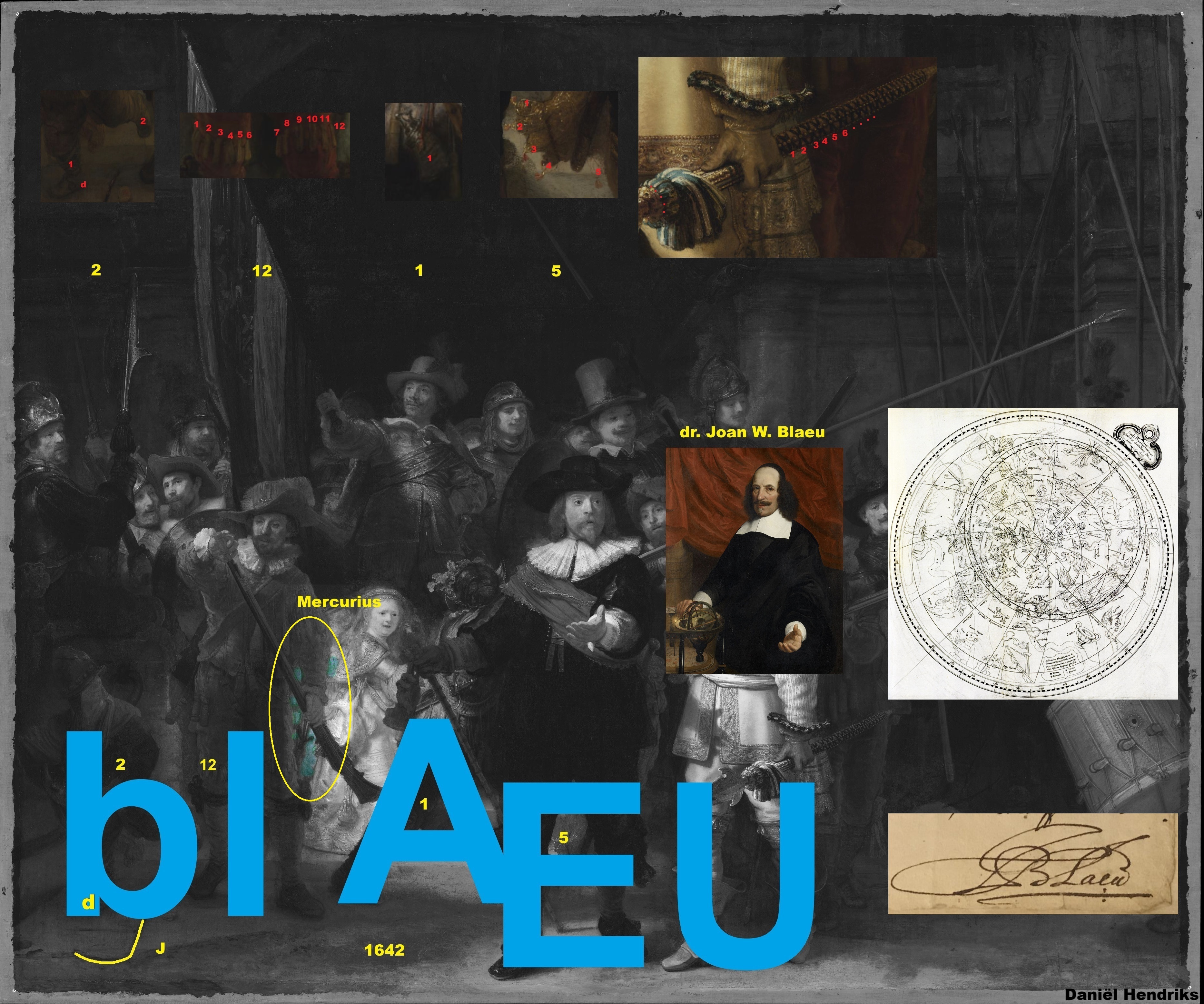
Dr. Joan Willemsz. Blaeu (1598 – 1673) – court cartographer of the VOC and publisher of the Atlas Maior – signs The Night Watch with a hidden typographic poem. When the canvas is laid flat like a star chart, five militiamen in the foreground form the letters B L A E U (or BLAEV), complete with two extra initials d and J. In this way…
Compare for yourself
Use Compare to inspect the original and the project’s interpretation at the same scale.
Open the interactive painting →Full project notes
Dr. Joan Willemsz. Blaeu (1598 – 1673) – court cartographer of the VOC and publisher of the Atlas Maior – signs The Night Watch with a hidden typographic poem. When the canvas is laid flat like a star chart, five militiamen in the foreground form the letters B L A E U (or BLAEV), complete with two extra initials d and J. In this way Blaeu fixes not only the heavens but also his authorship in human figures, numbers, and colours.
The hidden letters
- d – minutely painted on the left toe cap of the left-most musketeer: the first reference to doctor.
- J – a prominent joint line in the paving stone at lower-left forms a clear J; visible only if you follow the floor pattern.
- B – the two curved legs of the front-left musketeer outline the shape of a b; the number 2 (two legs) reinforces the idea.
- L – the angle between the legs of the second musketeer plus 12 bullet buttons on his breeches: L is the 12th letter.
- A – one leg + one powder flask of the central captain provide the diagonals for the capital A; A is the 1st letter.
- E – at the end of the sash hang five red ribbons; the number 5 points to E as the 5th letter.
- U – on the lieutenant, the blue plumes and the black crosses on the shaft mark the number 20 of the letter U/V in Blaeu’s time.
Colour code
The cobalt-blue doublet of the Mercury boy behind the girl is the only vivid blue in the tableau and serves as a chromatic signature: “bl-AE-u” in the language of paint.
Star print & compass
On the right we have added a circular star map that refers directly to Blaeu’s own celestial prints. Blaeu’s portrait closely resembles that of the captain in black.
Detail to watch
Zoom in on the tiny lead-white dot on the rim of the powder flask (A): that point marks Mercury’s ecliptic longitude on 8 October 1642—a final jest in which Blaeu dovetails his chart, his name, and reality.
Sources and astronomical comparison
The interpretation on this page belongs to this project. The references below come from the notes. A Stellarium comparison shows the specified sky configuration; it is not, by itself, a historical source for Rembrandt’s intention.
View the astronomical comparison in Stellarium ↗
No separate source references have been added for this subject yet.
About the research and its authorTechnical data and coordinates
Stellarium data
| Property | Value |
|---|---|
| object | mercury |
| dateTime | 1642-10-08T04:30:00Z |
| lat | 52.377956 |
| lng | 4.89707 |
| fov | 40 |
Coordinates on the Night Watch (3734 × 3113)
Region 1
| Number | Coordinates |
|---|---|
| 1 | 197, 2467 |
| 2 | 221, 2823 |
| 3 | 227, 2963 |
| 4 | 399, 2984 |
| 5 | 461, 2844 |
| 6 | 2498, 2993 |
| 7 | 2489, 2513 |
Region 2
| Number | Coordinates |
|---|---|
| 1 | 2168, 2420 |
| 2 | 2200, 2534 |
| 3 | 2784, 2236 |
| 4 | 2738, 2168 |
Region 3
| Number | Coordinates |
|---|---|
| 1 | 598, 2320 |
| 2 | 613, 2461 |
| 3 | 937, 2467 |
| 4 | 917, 2315 |