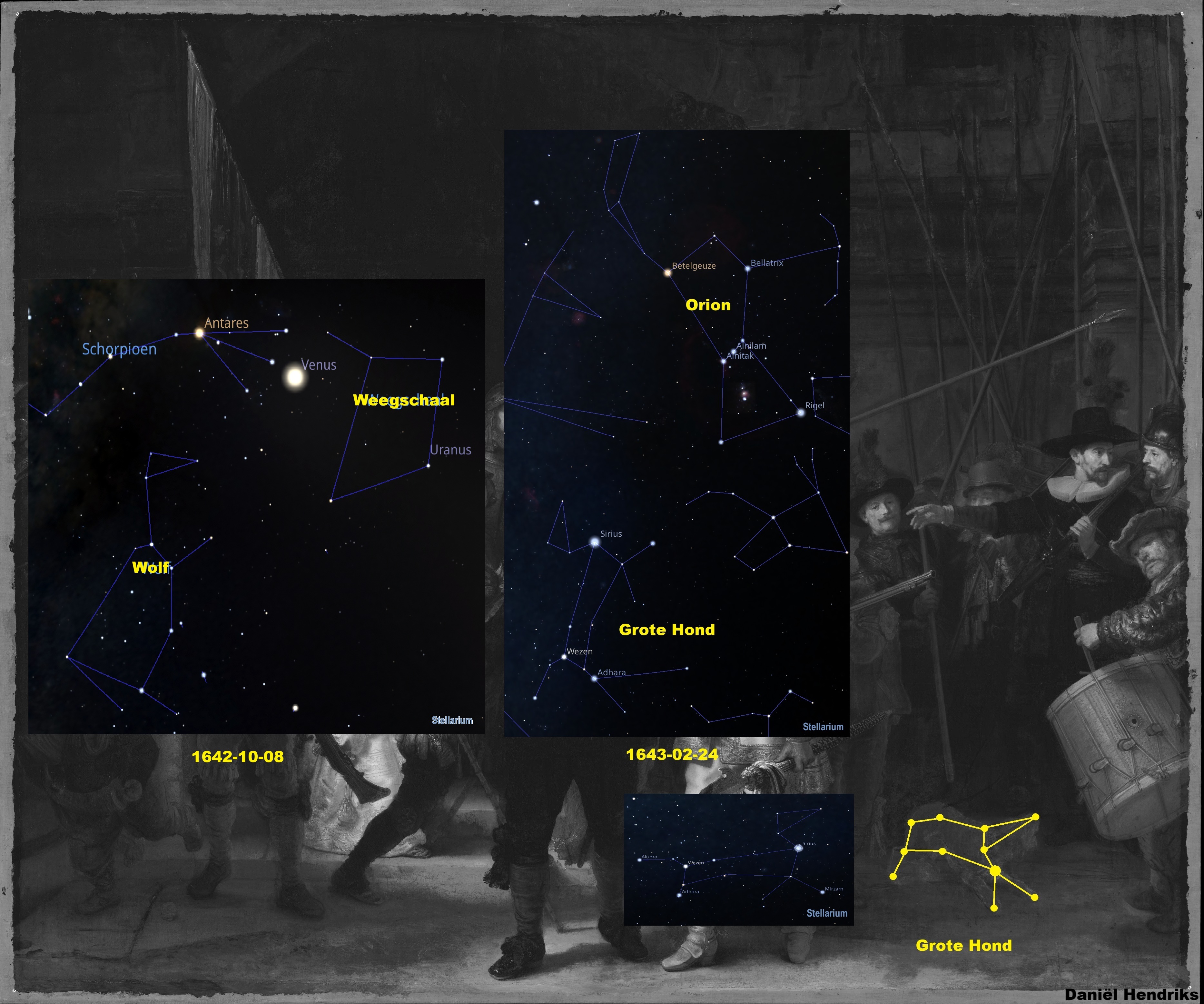
constellation
Great Dog (CMa)
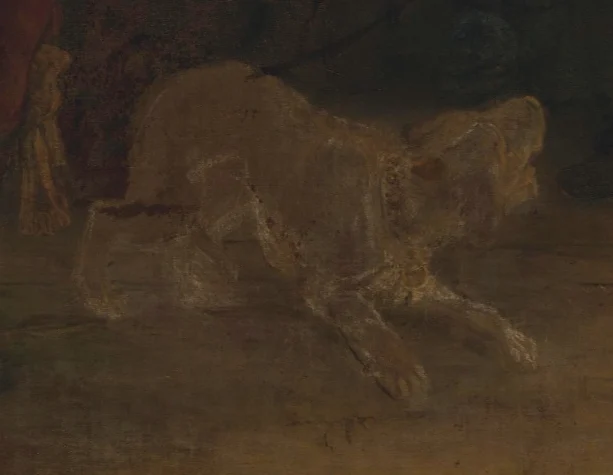
What you see
The crop shows the marked area in the original painting. Inspect its shapes, colours and position.
The project’s interpretation
Great Dog (Canis Major) is literally brought to life in The Night Watch as the resting dog in the lower-right corner. Its prone pose beneath Orion’s crossed spears matches exactly the sky position of Canis Major on the evening of 24 February 1643—the night of the celebrated Jupiter–Saturn conjunction that dominates the painting’s entire…
Compare for yourself
Use Compare to inspect the original and the project’s interpretation at the same scale.
Open the interactive painting →Full project notes
Great Dog (Canis Major) is literally brought to life in The Night Watch as the resting dog in the lower-right corner. Its prone pose beneath Orion’s crossed spears matches exactly the sky position of Canis Major on the evening of 24 February 1643—the night of the celebrated Jupiter–Saturn conjunction that dominates the painting’s entire right half.
Orientation & placement
Lay the canvas flat like a star chart: above the dog rises the Orion-spears field, to the left sit the Pleiades and the half-Moon from the same winter sky. The dog lies a hand’s breadth below Orion’s Belt, just where Canis Major appears overhead. Its head tilts slightly left—toward the point where Sirius flashed its first sparkle that evening just above the horizon.
Sirius as name tag
An oval brass tag dangles from the collar; a minuscule dab of lead-white is placed where it catches the light. That single dot represents Sirius, the brightest star in the sky. Blaeu uses the same micro-signature technique as for Jupiter’s moons: one pinprick of paint captures a star that normally pierces the darkness.
Conjunction context
During the Jupiter–Saturn alignment, Sirius, Mars, and the Moon formed a diagonal pointing toward the planets. In the painting, the dog’s gaze (up and left) traces that same line toward the white lieutenant (Jupiter) and the black-clad captain (Saturn). Canis Major thus becomes the visual guide to the winter triangle in Blaeu’s hidden planetarium.
Detail to watch
Zoom in on the faint glow around the dog’s paw: the slightly lighter pigment there marks the hazy Messier 41 open cluster just south of Sirius—further proof that Rembrandt and Blaeu did not forget the “small neighbours” in their cosmic map.
Sources and astronomical comparison
The interpretation on this page belongs to this project. The references below come from the notes. A Stellarium comparison shows the specified sky configuration; it is not, by itself, a historical source for Rembrandt’s intention.
View the astronomical comparison in Stellarium ↗
No separate source references have been added for this subject yet.
About the research and its authorTechnical data and coordinates
Stellarium data
| Property | Value |
|---|---|
| object | canismajor |
| dateTime | 1643-02-24T18:00:00Z |
| lat | 52.377956 |
| lng | 4.89707 |
| fov | 40 |
Coordinates on the Night Watch (3734 × 3113)
| Number | Coordinates |
|---|---|
| 1 | 2837, 2505 |
| 2 | 2758, 2721 |
| 3 | 3160, 2820 |
| 4 | 3211, 2531 |