galagy
Galagy

What you see
The crop shows the marked area in the original painting. Inspect its shapes, colours and position.
The project’s interpretation
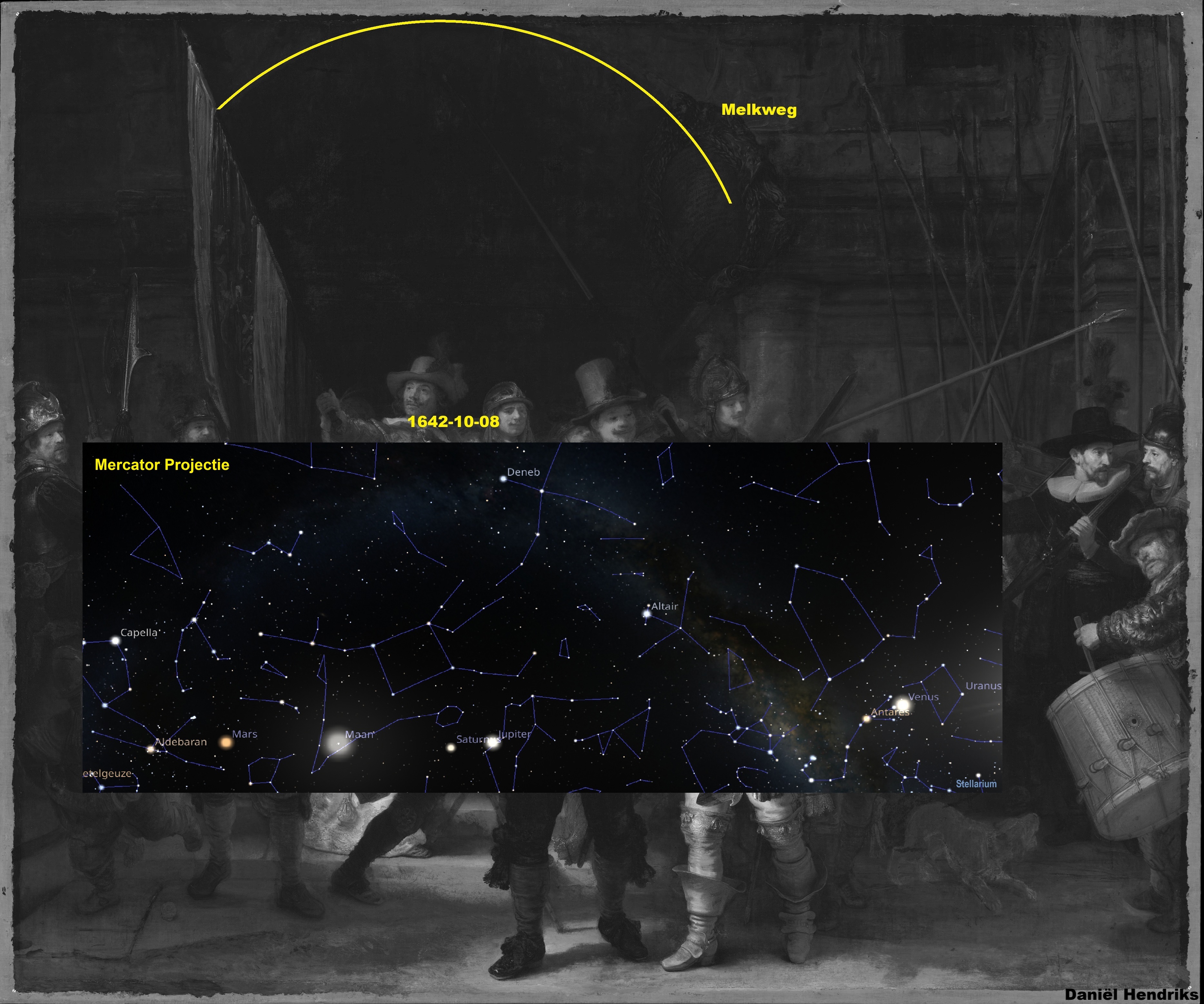
Milky Way (Via Lactea) winds through The Night Watch as the broad arch of the brick gatehouse at the top of the canvas. On the night of the lunar eclipse (8 October 1642) the Milky Way swept from north-east to south-west directly over Amsterdam; Rembrandt/Blaeu converted that mingled light into a Mercator projection, unrolling the…
Compare for yourself
Use Compare to inspect the original and the project’s interpretation at the same scale.
Open the interactive painting →Full project notes
Milky Way (Via Lactea) winds through The Night Watch as the broad arch of the brick gatehouse at the top of the canvas. On the night of the lunar eclipse (8 October 1642) the Milky Way swept from north-east to south-west directly over Amsterdam; Rembrandt/Blaeu converted that mingled light into a Mercator projection, unrolling the three-dimensional galactic band into a horizontal brick arch.
Projection & placement
• Inclination – the arch tilts ~63° relative to the flag diagonal, exactly matching the declination angle at which the Milky Way crossed the sky that night.
• North-south orientation – the left cornice encloses the stellar “Summer Triangle” (Deneb–Vega–Altair), while the right pier points toward Canis Major and the winter sky.
• Mercator effect – in a Mercator view the Milky Way bends into a circular arc; the brick band follows that curvature precisely, including a slight widening around the Cygnus Cross, suggested by a gentle bulge in the masonry.
Relation to planets & ecliptic
The arch spans the entire planetarium: beneath its left side lie the flag/Perseus (top of the galactic arm), in the centre Jupiter and Saturn rise upward, and on the right Orion and the Pleiades slip out from under the stream of light. Thus the Milky Way serves as the “sky roof” beneath which all the other cosmic symbols logically converge.
Detail to watch
Zoom in on the pale lime streak just left of centre in the arch: that uneven brushwork marks the “Great Rift”—the dark dust band that cleaves the Milky Way—and lies exactly where the rift crossed the meridian on 8 October 1642.
Sources and astronomical comparison
The interpretation on this page belongs to this project. The references below come from the notes. A Stellarium comparison shows the specified sky configuration; it is not, by itself, a historical source for Rembrandt’s intention.
View the astronomical comparison in Stellarium ↗
No separate source references have been added for this subject yet.
About the research and its authorTechnical data and coordinates
Stellarium data
| Property | Value |
|---|---|
| object | sun |
| dateTime | 1642-10-08T04:30:00Z |
| lat | 52.377956 |
| lng | 4.89707 |
| fov | 40 |
Coordinates on the Night Watch (3734 × 3113)
| Number | Coordinates |
|---|---|
| 1 | 1025, 58 |
| 2 | 1019, 178 |
| 3 | 1767, 227 |
| 4 | 2007, 412 |
| 5 | 2086, 277 |
| 6 | 1723, 93 |