constellation
Perseus (Per)
What you see
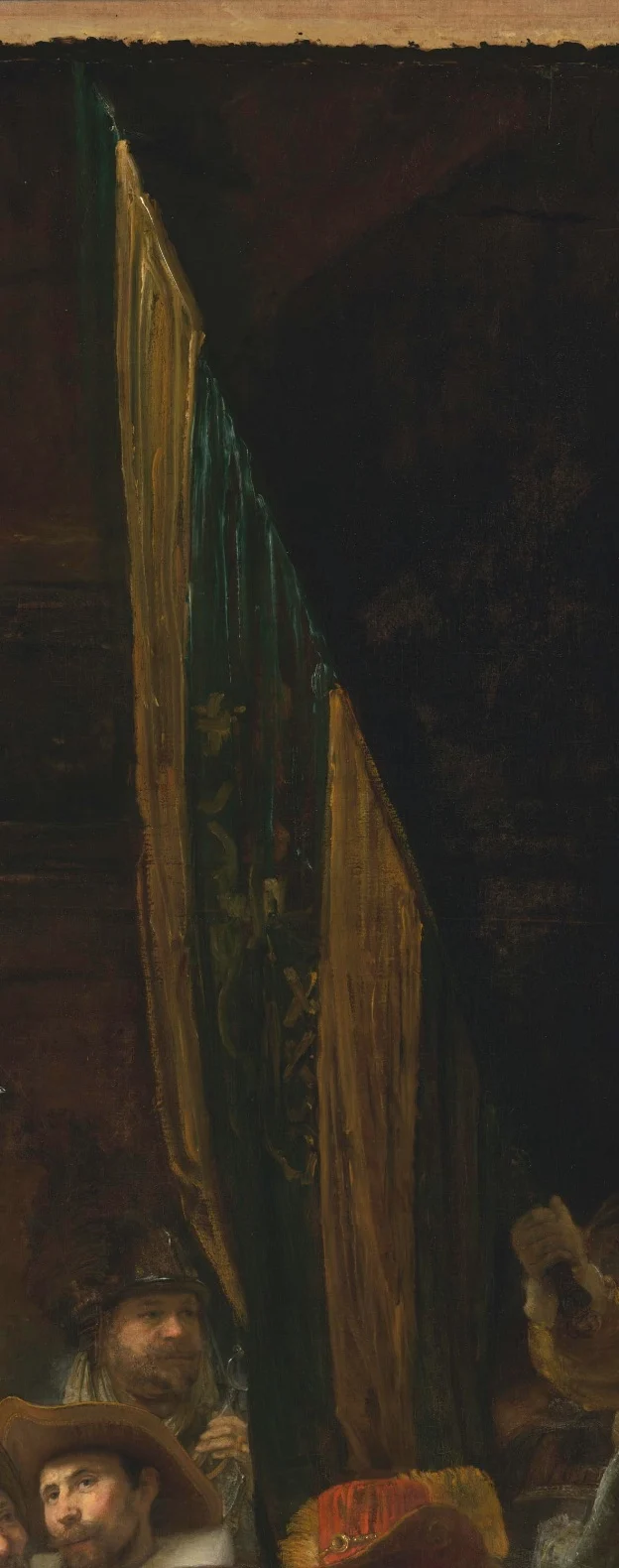
The large banner hangs above the group on the left. Notice its folds and diagonal lines.
The project’s interpretation
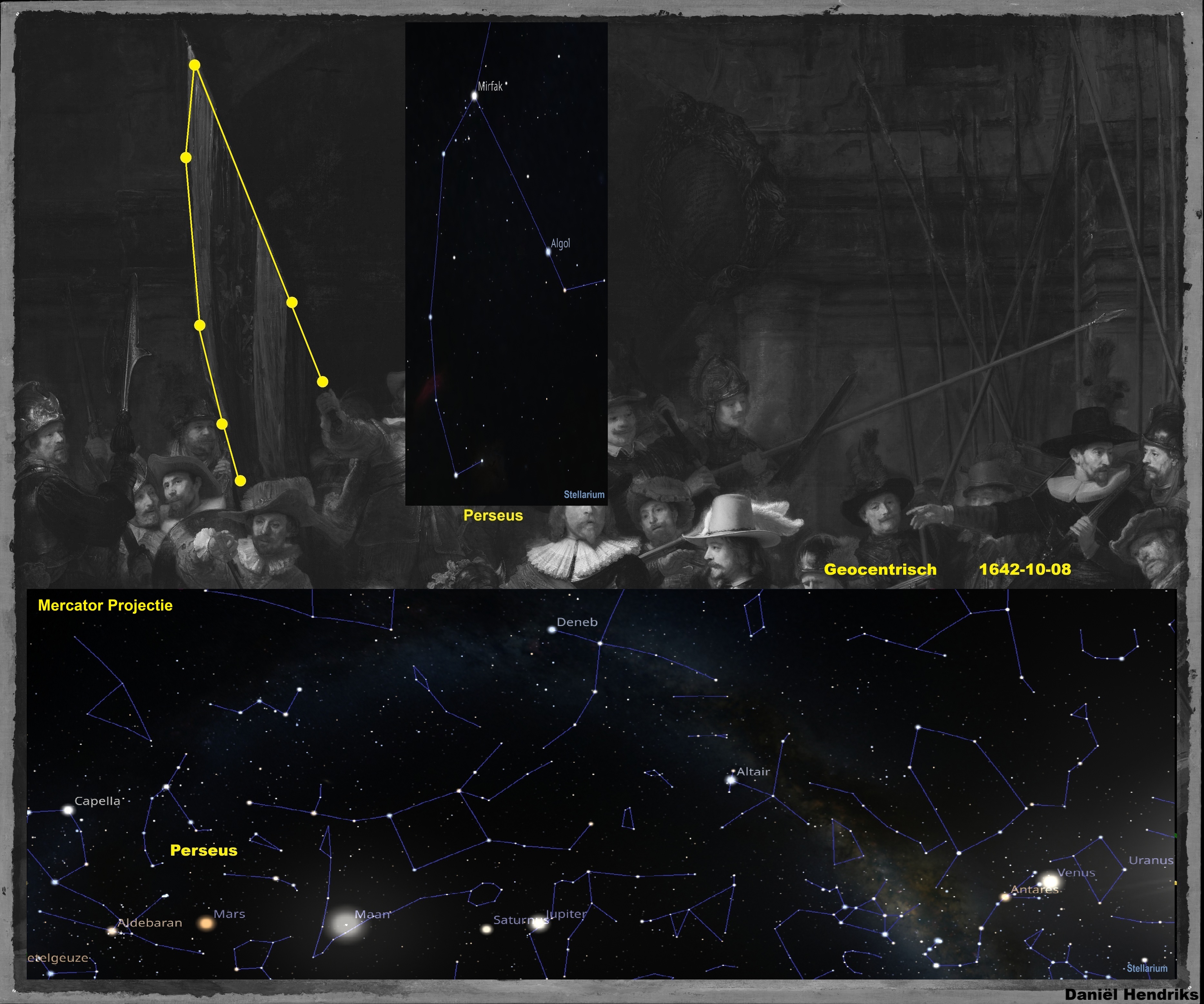
The astronomical interpretation associates the banner with Perseus.
Compare for yourself
Examine which folds serve as reference points and compare them with the star chart.
Open the interactive painting →Full project notes
Perseus is, on the night of 8 October 1642, a familiar winter figure in the north-eastern sky. Seen from Amsterdam, the constellation had already climbed above the treeline shortly after the lunar eclipse, with Mirfak (α Per) as a bright spear-tip and the eye-catching Algol (β Per) a little lower on the sword arm. Rembrandt transforms that pattern in The Night Watch into the fluttering company flag: the five main knots in the fabric follow exactly the angular line of Perseus’s principal stars.
Orientation and polar direction
The flag tilts about 23½°—virtually the same angle as that between the ecliptic and Earth’s axis—serving as a visual reminder of terrestrial obliquity. Follow the staff to its very tip and you arrive at the Pole Star; on the canvas it appears as a minute highlight at the point of the banner and receives further explanation on the separate Ursa Major page. In this way a single gesture links both Earth’s axis and the celestial north to the composition.
Seen from Earth
A constellation exists solely by our perspective; heliocentrically the distances between its individual stars expand into tens or hundreds of light-years. Yet their projection onto the celestial sphere from Earth remains strikingly stable, so the flag—unlike the wandering planets—needs play no double role. It simply marks where Perseus stood in the sky in 1642 and provides a fixed “north-east” reference in Rembrandt’s hidden map.
Compositional role
Although a constellation may seem less spectacular than a planet, the flag quietly serves as a compass. It links the dynamic group of planets (Jupiter, Saturn, Mars) to the fixed background through the same diagonal stroke that Perseus traces across the sky. The flag line helps the viewer grasp the entire astronomical grid within the painting: follow the fabric’s folds and you inevitably reach the planets on the left and the eclipsed Moon on the right.
Detail to watch
Zoom in on the golden hem along the upper edge: where the cloth suddenly billows forward you will find the equivalent of Algol—the Devil’s Eye—a subtle knot of light with which Rembrandt even hinted at that star’s notorious variability.
Sources and astronomical comparison
The interpretation on this page belongs to this project. The references below come from the notes. A Stellarium comparison shows the specified sky configuration; it is not, by itself, a historical source for Rembrandt’s intention.
View the astronomical comparison in Stellarium ↗
No separate source references have been added for this subject yet.
About the research and its authorTechnical data and coordinates
Stellarium data
| Property | Value |
|---|---|
| object | Perseus |
| dateTime | 1642-10-08T04:30:00Z |
| lat | 52.3676 |
| lng | 4.9041 |
| fov | 40 |
Coordinates on the Night Watch (3734 × 3113)
| Number | Coordinates |
|---|---|
| 1 | 545, 73 |
| 2 | 633, 1192 |
| 3 | 728, 1500 |
| 4 | 931, 1457 |
| 5 | 1009, 1204 |