planet
Earth (3)
What you see
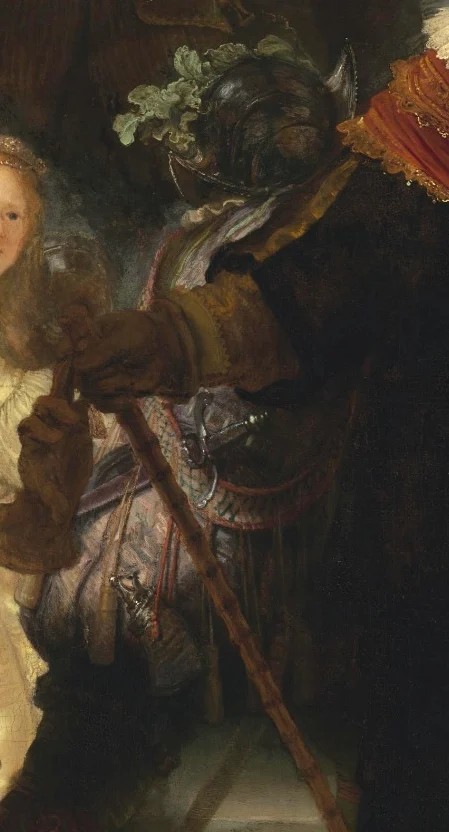
The crop shows the marked area in the original painting. Inspect its shapes, colours and position.
The project’s interpretation
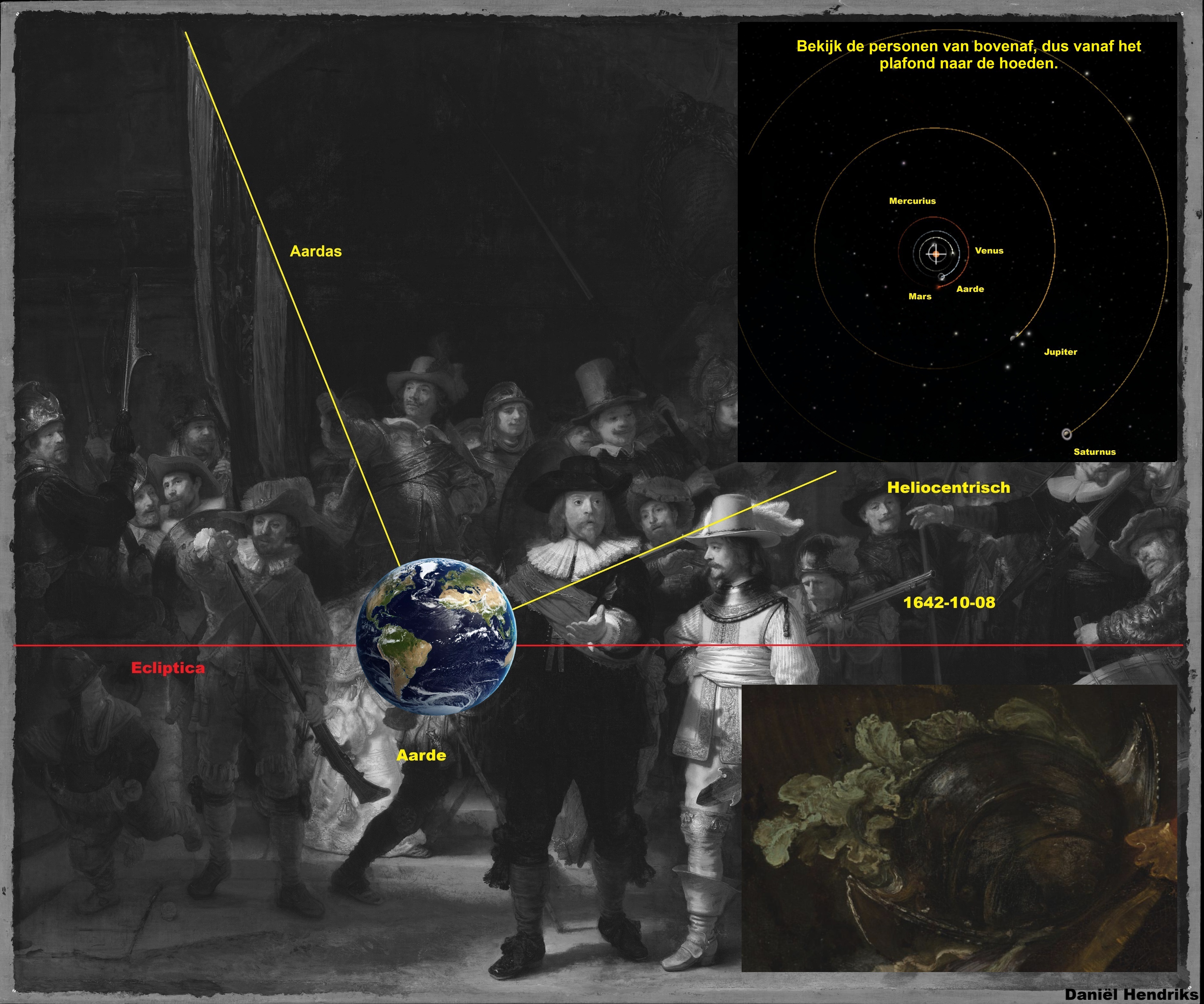
Earth appears in The Night Watch as the musketeer with the rifle and oak leaves on his helmet. His position at the centre of the action—precisely between the Radiant Girl (Sun) and the red sash (Blood Moon)—makes him the natural reference point for the entire heliocentric scheme. Heliocentric view (seen from above) Lay the painting…
Compare for yourself
Use Compare to inspect the original and the project’s interpretation at the same scale.
Open the interactive painting →Full project notes
Earth appears in The Night Watch as the musketeer with the rifle and oak leaves on his helmet. His position at the centre of the action—precisely between the Radiant Girl (Sun) and the red sash (Blood Moon)—makes him the natural reference point for the entire heliocentric scheme.
Heliocentric view (seen from above)
Lay the painting horizontally like a planetarium and look down on it: the marksman stands one astronomical unit (1 AU) from the Sun-Girl. His musket tilts 23½° relative to the flag diagonal—exactly the obliquity of Earth’s axis to the ecliptic. The flag/Perseus line functions as the celestial prime meridian, the musket as Earth’s axis; together they create the cosmic cross on which all the other orbits are plotted.
No geocentric counterpart
From Earth you cannot observe Earth itself; therefore this model exists only in the heliocentric projection. In the frontal (geocentric) viewpoint, the musketeer “vanishes,” and instead you see the Blood Moon and the surrounding planets. His physical presence in paint thus replaces our impossible view of our own globe.
Military-cosmic symbolism
The bright shot represents the solar flash at the eclipse of 20 March 1643; the recoil smoke forms Earth’s atmosphere. The oak leaves—symbols of steadfastness—sit exactly where the Polaris line crosses his head, marking both the planet’s axis and the cycle of the seasons.
Detail to watch
Zoom in on the pearly gleam on the central oak leaf: that dab of lead white lies precisely at the intersection of the flag diagonal (ecliptic) and the musket axis (Earth’s axis). With a single pinpoint of paint Rembrandt balances the entire spinning world.
Sources and astronomical comparison
The interpretation on this page belongs to this project. The references below come from the notes. A Stellarium comparison shows the specified sky configuration; it is not, by itself, a historical source for Rembrandt’s intention.
View the astronomical comparison in Stellarium ↗
No separate source references have been added for this subject yet.
About the research and its authorTechnical data and coordinates
Stellarium data
| Property | Value |
|---|---|
| object | sun |
| dateTime | 1642-10-08T04:30:00Z |
| lat | 52.377956 |
| lng | 4.89707 |
| fov | 40 |
Coordinates on the Night Watch (3734 × 3113)
| Number | Coordinates |
|---|---|
| 1 | 1375, 1771 |
| 2 | 1291, 2443 |
| 3 | 1580, 2355 |
| 4 | 1560, 1785 |