zodiac
Libra (Lib)
What you see
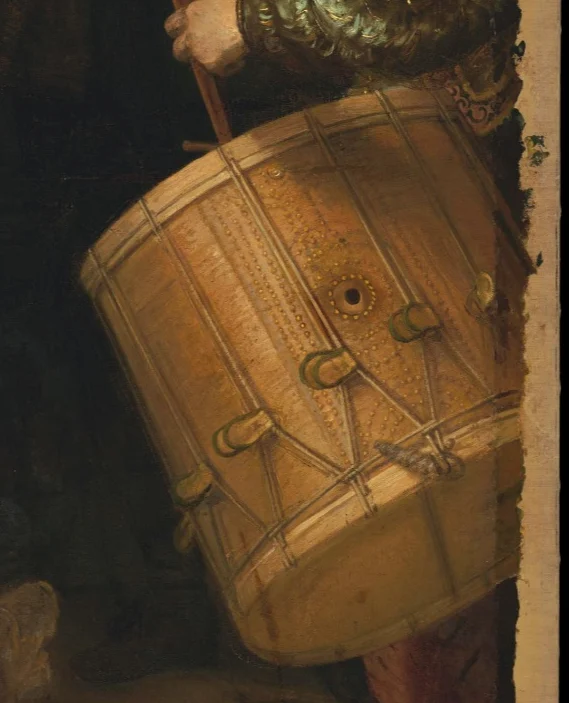
The drum is in the lower right. Look at its round shape, rim and taut cords.
The project’s interpretation
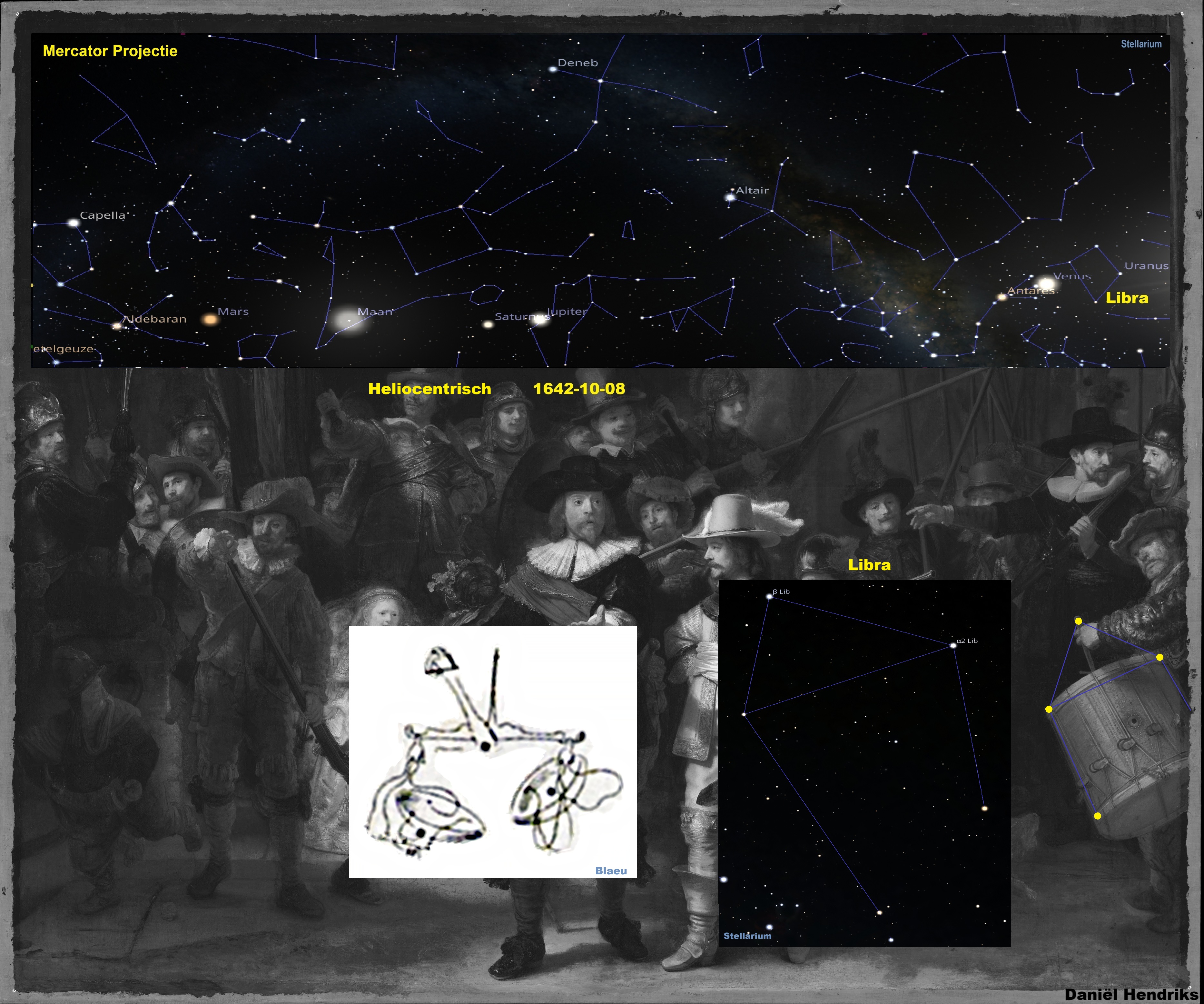
The project reads the drum as a representation of Libra.
Compare for yourself
Compare the shape of the drum with the interpretation and inspect the corresponding position in Stellarium.
Open the interactive painting →Full project notes
Libra is the only figure of the zodiac that represents not a person or an animal but an attribute: a pair of balance scales. Around the lunar eclipse of 8 October 1642, the Sun lay in this constellation; it therefore sat low in the east, exactly opposite the eclipsed Moon on the celestial dome. Rembrandt moved that invisible “Sun side” onto the canvas by painting the drummer’s drum in the lower right as an abstract Libra: the round kettle symbolizes the fulcrum, while the taut skins suggest the two pans.
Orientation and timing
Because the Sun was in Libra, the constellation itself was washed out by the first twilight. Yet the placement in the painting is correct: the drum lies down to the lower right of Saturn and Jupiter—precisely where Libra appeared in the sky when one folds the night sky 180° onto the picture plane. Thus the drum serves as a visual anchor for the ecliptic line, comparable to the flag/Perseus diagonal elsewhere in the work.
Hidden surprise: Uranus
A small, dark sound hole in the skin is no damage but marks the spot where the still-unknown Uranus stood—explained in more detail on the separate Uranus page. In this way a future planet literally settles in the heart of Libra, as though Rembrandt (or Blaeu) had already made space for later discoveries.
Compositional role
Like the flag, the drum functions as an orientation device: from the circular rim you can draw an imaginary line to the illuminated girl (the Sun) and from there to the eclipsed Moon, allowing the viewer intuitively to sense the link between Libra, the ecliptic, and the eclipse. The fixed stellar background thus gains a tangible counterpart in the world of the militiamen.
Detail to watch
Zoom in on the gleam of the brass tension rings: the two brightest highlights correspond to Zubenelgenubi (α Lib) and Zubeneschamali (β Lib)—the southern and northern scales. Together they, like the real Libra, maintain cosmic balance in this part of The Night Watch.
Sources and astronomical comparison
The interpretation on this page belongs to this project. The references below come from the notes. A Stellarium comparison shows the specified sky configuration; it is not, by itself, a historical source for Rembrandt’s intention.
View the astronomical comparison in Stellarium ↗
No separate source references have been added for this subject yet.
About the research and its authorTechnical data and coordinates
Stellarium data
| Property | Value |
|---|---|
| object | Libra |
| dateTime | 1642-10-08T04:30:00Z |
| lat | 52.377956 |
| lng | 4.89707 |
| fov | 40 |
Coordinates on the Night Watch (3734 × 3113)
| Number | Coordinates |
|---|---|
| 1 | 3245, 2200 |
| 2 | 3413, 2563 |
| 3 | 3667, 2503 |
| 4 | 3607, 2020 |