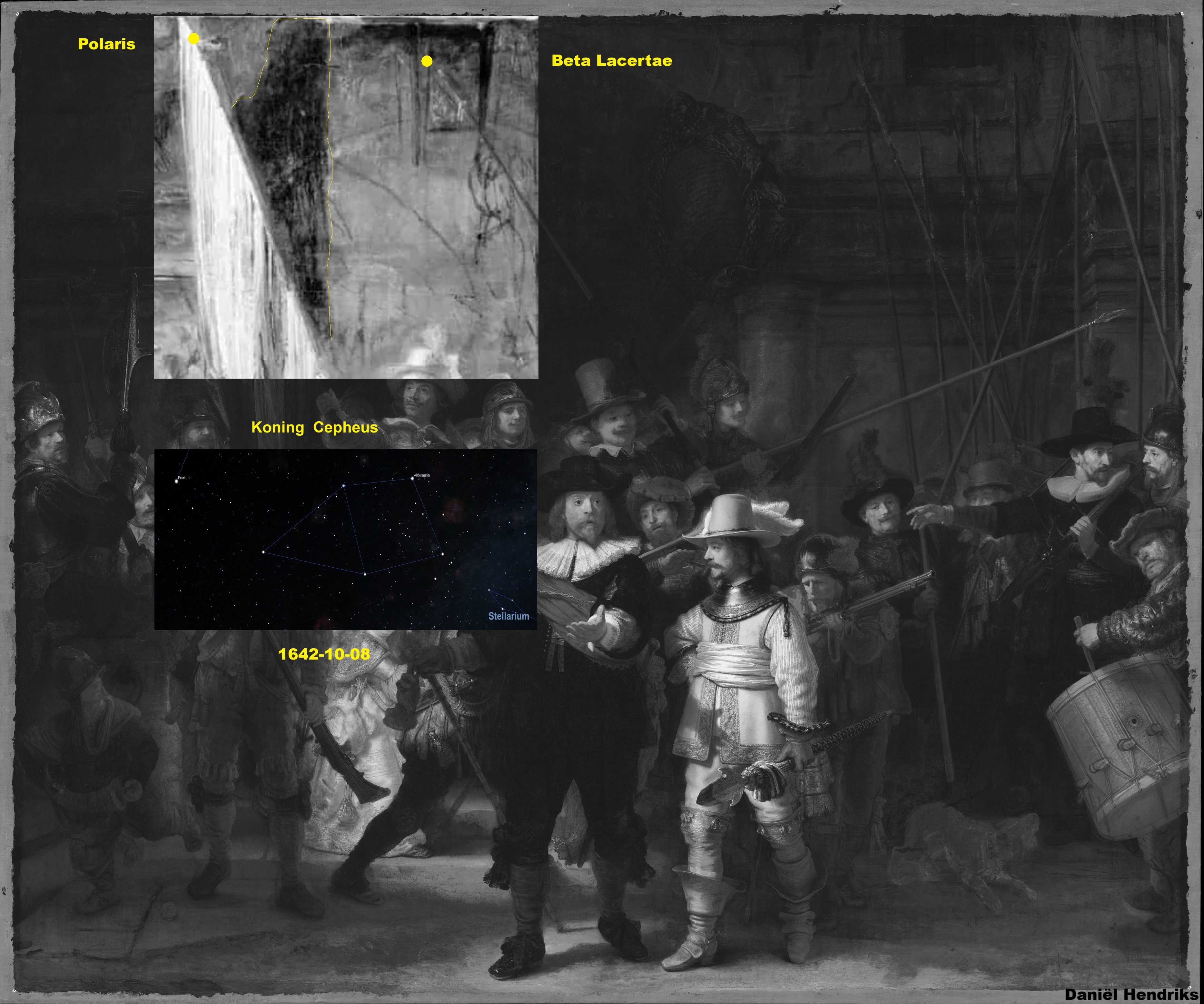
constellation
Royal Stars (Cep)
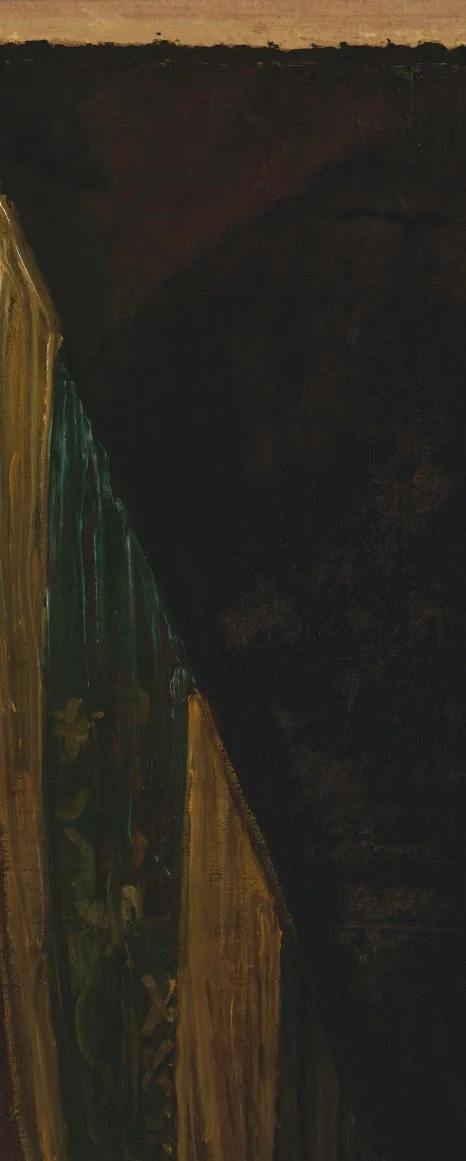
What you see
The crop shows the marked area in the original painting. Inspect its shapes, colours and position.
The project’s interpretation
Royal Stars (Cepheus) lie dormant in The Night Watch as a shadowy figure that appears on X-rays to the right of the large flag. In the visible paint layer he is almost erased, yet beneath the overpainting the five-sided outline of King Cepheus still emerges—exactly where, in 1642, he stood in the sky between Polaris (the tip of the…
Compare for yourself
Use Compare to inspect the original and the project’s interpretation at the same scale.
Open the interactive painting →Full project notes
Royal Stars (Cepheus) lie dormant in The Night Watch as a shadowy figure that appears on X-rays to the right of the large flag. In the visible paint layer he is almost erased, yet beneath the overpainting the five-sided outline of King Cepheus still emerges—exactly where, in 1642, he stood in the sky between Polaris (the tip of the flagstaff) and Hagadis (the small flag).
X-ray revelation
The scan shows a dark mantle, crown, and sceptre. Their contours trace the key stars α, β, γ, δ, and ε Cephei, with the “crown” on β Cep. That the figure was later painted over suggests a deliberate choice: the king had to vanish to the naked eye yet survive in the underdrawing as an astronomical reference.
Role in the compass system
Together with Ursa Major (left) and Perseus/Hagadis (right), Cepheus forms a triad that pins down the northern sky—and thereby Earth’s axis. Draw a line upward from his “crown” and it hits Polaris; extend the same line downward and it touches the darkened section of the small flagstaff that defines Hagadis. Thus the hidden king anchors the entire north-eastern sector of the cosmic grid.
Seventeenth-century symbolism
In Blaeu’s day King Cepheus stood for the rex justus: the righteous ruler who keeps heaven and earth in balance. By placing him literally beneath the surface, the painting suggests that true authority is invisible yet decisive—a reflection that suited the political tensions of 1642-43.
Detail to watch
Zoom in on the tiny lead-white dot just above the crown’s rays: that speck marks α Cephei (Alderamin) on 8 October 1642. One hidden dab of paint holds an entire royal constellation together.
Sources and astronomical comparison
The interpretation on this page belongs to this project. The references below come from the notes. A Stellarium comparison shows the specified sky configuration; it is not, by itself, a historical source for Rembrandt’s intention.
View the astronomical comparison in Stellarium ↗
No separate source references have been added for this subject yet.
About the research and its authorTechnical data and coordinates
Stellarium data
| Property | Value |
|---|---|
| object | cepheus |
| dateTime | 1642-10-08T04:30:00Z |
| lat | 52.377956 |
| lng | 4.89707 |
| fov | 40 |
Coordinates on the Night Watch (3734 × 3113)
| Number | Coordinates |
|---|---|
| 1 | 794, 58 |
| 2 | 803, 184 |
| 3 | 689, 318 |
| 4 | 993, 1081 |
| 5 | 995, 58 |